Care management for athenahealth practices · on the Marketplace
The cognitive work of care, finally counted — in athenaOne.
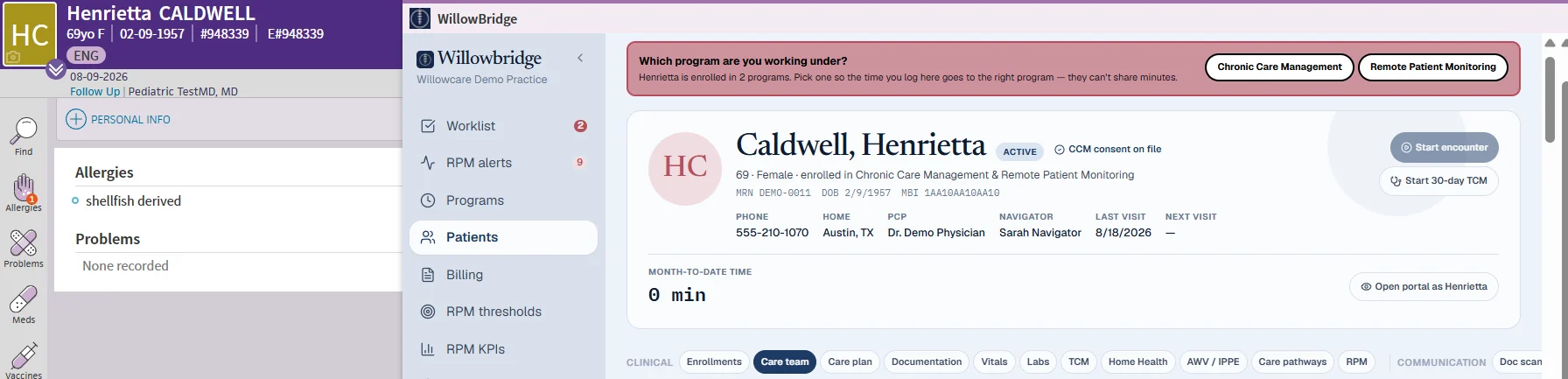
willowbridge captures every minute your team spends keeping Medicare patients out of the ER — chart review, phone calls, medication reconciliation, family conversations — signs the clinical attestation, and hands the structured charge to athenaOne. athenaOne bills and collects. No new biller, no new clearinghouse, no PDF-shuffle between systems.
The hard part isn't the care. It's knowing who qualifies for what.
A dozen Medicare programs, each with its own conditions, exclusions, and attestations — and the patients who qualify are already on your schedule. willowbridge treats that as a rules problem, because it is one.
TODAY'S SCHEDULE
Screened before they walk in.
Each morning willowbridge takes the day's appointment list — not your whole panel, just who is actually coming in — reads each patient's active problem list, and scores them against every program your practice operates.
The answers land on the schedule itself, as chips against each name, before the visit. If a candidate has no chart yet, one can be created straight from that row.
THE RULES ENGINE
Twelve programs, and it tells you why.
Every program gets one of three answers, each with its reason: qualifies, needs a clinician's attestation, or not eligible — and it names what's missing. Needs ≥2 chronic conditions (found 1). No behavioral diagnosis found.
It is deliberately conservative. Anything resting on clinical judgement — serious illness, high risk, chronic pain, homebound — comes back as needs attestation rather than a false yes. The same criteria drive the real enrollment gate, so what the screen promises and what the system will actually let you bill cannot drift apart.
AFTER ENROLLMENT
A new diagnosis reopens the question.
Screening doesn't stop at enrollment. When a new problem reaches the chart from athenaOne — a second chronic condition, an F-code, a pain diagnosis — that patient returns to the top of the worklist flagged for an eligibility re-look, and stays there until someone acts or the flag ages out.
And it knows which programs stack and which collide. Most combine freely — chronic care alongside remote monitoring alongside behavioral health. A few never can: Advanced Primary Care Management won't share a month with CCM, PCM or TCM, and the two remote-monitoring programs are mutually exclusive. Others collide only in certain circumstances — CCM and PCM just when they target the same principal condition; CCM and TCM only where the 30-day discharge window overlaps the month. willowbridge blocks the pairings that can never bill, and where a month is merely contested it keeps the higher-paying claim instead of dropping both.
Capture · Document · Defend
One workflow. Every billable minute.
The hardest part of care management isn't the care — it's tracking it in a way that's still defendable in November when an auditor asks about a claim from March. willowbridge runs the whole loop: one encounter timer captures the time, drafts the note from the chart, and queues the claim with its audit packet pre-assembled. Your team works the panel; the billing happens around them.
1
A timer attached to the work, not a Post-it.
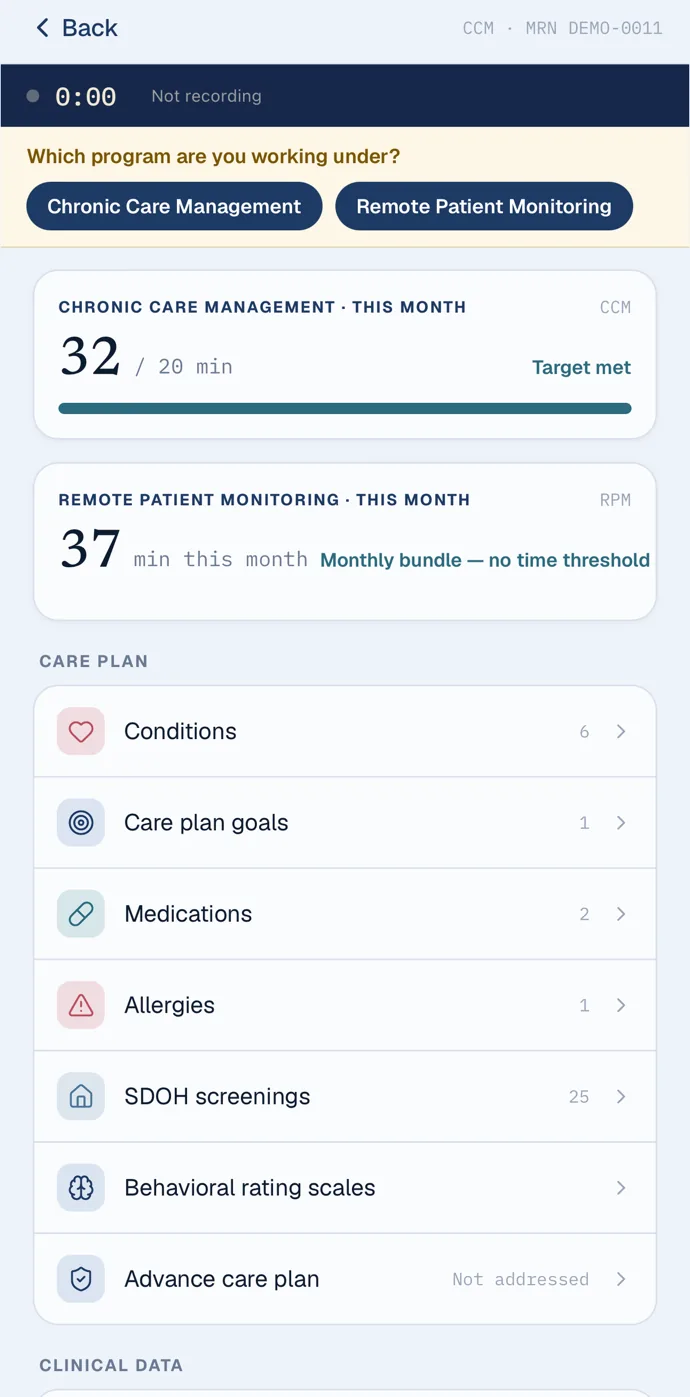
One tap starts an encounter from a worklist row, the chart, or the willowbridge care app on your phone, and opening willowbridge from a patient's chart inside athenaOne lands you on that patient's chart. The mm:ss counter rides at the top of the screen the whole time the encounter is open, with the month-to-date total broken out by program (CCM, PCM, BHI, RPM, TCM) so you always know whether you're under, at, or over a billable tier. The clock pauses when you switch context, resumes when you return, and rolls up cumulative time across the whole care team for the calendar month.
2
The care plan starts from a template, not a blank page.
Twenty condition templates — heart failure, diabetes, COPD, CKD, depression, opioid use disorder and the rest — each proposing a primary problem and four or five SMART goals. The clinician picks what fits; every goal carries a plain-language reason the patient can read and a guideline citation for the chart. For principal care management there are Care Pathways: guideline-aligned protocols for CHF, diabetes, CKD, hypertension, COPD and atrial fibrillation, tracked item by item from not-started to at-target. Decision support, cited — never a directive.
3
Topic chips that pre-structure the note.
Tap "medication adherence," "symptom check," "care plan review," "SDOH" — and willowbridge drafts a clinical narrative from the chart under each section header. You write prose into structure, not into a blank page. The note links automatically to the encounter and the rendering provider, with the right CPT code already attached.
4
Sign as you go. Review the month in one pass.
The rendering provider signs each encounter as it happens, not in a stack at month-end. There's still one monthly billing-period sign-off per program — but by the time it hits the review queue, the audit packet is already assembled, so it's a single review pass, not a reconstruction across 200 charts.
5
An audit packet on every claim.
Every submitted claim ships with a contemporaneous evidence file: consent on the date of service, care plan version pinned to that date, the time log with timestamps and signers, threshold-met indicator, modality, and place of service. When your MAC asks about a claim from March in November, you have the answer in seconds, not days.
Call rounds
Patient 12 of 40 · June outreach · timer running
HO
Hazel Obi · 81
CCM · (502) 555-0148 · last spoke May 14
📞 Document callSkipSnooze to Thursday
Next: Marcus Bell · 74 · CCM + RPM · the queue holds your place, so you never hunt the list twice.
Call outcome
Audio · 14:23 logged · attached to encounter #EC-4421
OUTCOME
✓ Spoke with patient · countedSpoke with caregiver · countedLeft voicemailNo answerPatient unavailableWrong numberAbandoned by clinician
PARTICIPANTS
✓ Patient+ Caregiver+ Family member+ Other clinician+ Interpreter
TOPICS DISCUSSED
✓ Medication adherence✓ Symptom check+ New labs✓ Care plan review+ Education+ Care coordination+ SDOH
CLINICAL NOTEauto-templated · edit freely
Two ways this lands
The same engine. Two very different first months.
A solo internist and a twenty-provider group both leave the same money on the table, but almost nothing else about their situation is alike. willowbridge is one product; which half of this page you should read depends on which one you are.
Solo & small · 1–5 providers
You are the practice manager, the compliance officer, and the physician.
One navigator — part-time at the start — is a viable program. The math works well before you need a second.
If the owner-physician is also the office manager, both roles ride one login. You don't need two people awake to enroll a patient and sign the month.
No implementation fee, no per-provider license, no monthly minimum. The downside of trying is a staff member's time, not a capital decision you have to defend.
Month-end is one pass through a billing review screen, not a chart-by-chart reconstruction.
Twelve programs, from CCM and RPM to the lines most practices never get to — Advanced Primary Care Management, Principal Illness Navigation, Behavioral Health Integration, Home Health oversight. willowbridge models the time thresholds, eligibility rules, consent requirements, and exclusion interactions for each one, and it knows which ones can't be billed together in the same month. Turn a program on, and the worklist updates the same day.
RPM you can stand up this week — and already on the right side of what CMS proposed.
Order the cuff, pair it, and your own staff work the readings from the same worklist as everything else. willowbridge counts the device days and the minutes, and holds the claim until the code’s threshold is genuinely met.
CMS has proposed that, from 2027, only a practice’s own employed clinical staff time count toward billable RPM — which would end the rent-a-call-center model. willowbridge has always been software your staff sign into, so there is nothing for you to change either way.
Proposed rule CMS-1848-P, published July 16, 2026; the comment period closed September 14, 2026, and the final rule is expected around November 1, 2026. Not final law — CMS may finalize it as written, modify it, or decline to finalize it. Information as of October 9, 2026; not legal or reimbursement advice.
The three things practices actually say
Every objection you have, we've already heard.
Care management has a credibility problem, and it earned it. Rather than pretend otherwise, here are the three sentences we hear most often in a first call — and the honest answer to each.
OBJECTION 01
“We tried this before. It didn't stick.”
The autopsy is almost always the same. Enrollment went fine. Then the minutes stopped getting recorded — not because nobody did the work, but because recording it meant remembering to start a stopwatch, then writing a note that justified the stopwatch, then someone reconciling all of it on the 30th. Three separate acts of discipline for one phone call. By month four the calls were still happening and the claims weren't.
willowbridge collapses those three into one. The timer starts when the chart opens. The note drafts itself from the topics you touched. The month reconciles continuously instead of at the end. And on the last week of the month, a sweep finds every patient sitting one contact short of a billable threshold and puts them at the top of the list — while there's still time to make the call.
OBJECTION 02
“Our EHR already has a module for this.”
It probably does, and it likely does two things well: it lets someone type a note, and it lets someone bill a code. What an EHR module generally will not do is decide which patients need a call today across a dozen overlapping programs, prove the twenty minutes were real when a payer asks about it in November, or refuse to bill a code that a program exclusion makes unbillable that month.
willowbridge is not a second chart and doesn't want to be. Reads come from athenaOne. Notes, care plans, vitals, and charges go back to athenaOne. athenaOne stays the system of record and the system that bills. willowbridge is the layer in between that decides what to do, captures the doing, and defends it afterward.
OBJECTION 03
“I don't have the staff to run it.”
This is the real one, and it deserves a straight answer: yes, this needs a person. Usually one navigator, often part-time at the start, scaling with the panel. What it does not need is a physician doing the work.
Every design decision assumes one non-clinical or nursing staff member working a list, with the physician appearing exactly twice — at enrollment consent, and at the month-end signature. In a solo practice where the owner is also the office manager, both roles sit on one login. And the day arrives already sorted: who's overdue, who happens to be in the office today anyway, who just left the hospital and started a clock.
There's a fourth question nobody asks out loud, so we'll answer it anyway: what happens if a payer comes back? That one has its own section.
The killer feature
A claim is only as good as the day someone asks about it.
Every billable period willowbridge signs has a complete, contemporaneous audit packet attached. Not a PDF you generated after the fact — a chained, timestamped record of who did what, when, and on which version of the care plan. If your MAC opens a TPE or sends an ADR, your response is already written.
✓
Activity log is append-only and signed — entries can't be backdated or edited silently.
✓
Care plan version is pinned to each calendar month so the right document defends the right claim.
✓
Consent capture, including the date and modality, lives on the patient timeline forever.
✓
One-click TPE / ADR response export — paginated, indexed, with a cover sheet your compliance lead can sign.
AUDIT PACKET · ID 99490-EM-04-2026
Edith Marsh · April 2026 · CCM 99490
Charge handed to your EHR May 02 · NPI ·········· · sample data
✓
Patient consent on file
Signed 2024-01-12 · verbal, witnessed by MA Aoki RN
POS 11 office · phone (95) · no F2F required for 99490
—
CLAIM TOTAL
$64.42
Export · PDF
Revenue protection
The money you lose isn't fraud. It's a deadline nobody was watching.
Practices don't usually lose care-management revenue by billing wrong. They lose it by billing late, billing nothing, or billing something a rule quietly disqualified nine days earlier. willowbridge spends most of its time watching for exactly that.
Discharge detection
The TCM clock starts before you hear about the discharge.
willowbridge watches for it three separate ways — a discharge encounter in the chart, a newly filed discharge summary, and an event notification from athenaOne — then opens the episode itself. The worklist counts down the two business days to interactive contact and the 7 or 14 days to the face-to-face, in the patient's row, in red.
Visit watchdog
A cancelled appointment is a lost claim nobody notices.
Every open TCM window is joined against the actual appointment book. If the visit inside the window gets cancelled or no-showed and nothing replaces it, that patient goes to the top of the list while the window is still open — not in December, when someone finally reconciles October.
Revenue at risk
Four numbers, all in dollars, all actionable today.
Periods frozen and waiting on a signature. Periods still open whose minutes already cleared the threshold — they'd bill today if someone closed them. Patients your last eligibility scan flagged who were never enrolled. Open quality gaps. Each carries its dollar figure, so the list gets worked in value order instead of alphabetically.
Exclusion engine
The claims that shouldn't go out, don't.
CCM and PCM in the same month. CCM inside a TCM window. Home-health oversight against APCM. RPM and RTM on one patient. willowbridge holds the charge rather than letting you bill it and repay it with interest eighteen months later — and it tells the navigator why, before the encounter starts.
Substantiation gates
A code that can't be defended never becomes a claim.
Advanced Primary Care Management won't bill a month with no documented care management, flat monthly fee or not. Chronic pain won't close its month without the PEG on file. Home-health oversight won't bill unless a certification episode actually covers the month. Principal Illness Navigation checks the navigator's certification first.
ROI statement
The one number a physician actually asks for.
Every month: what was billed, what willowbridge cost, what device pass-through cost, what's net to the practice — and the return multiple, revenue per dollar of total cost. Beside it, a lost-revenue report naming every period that closed unbilled and why. It's the report nobody wants to run and every practice should.
For patients · for retention
A care plan your patient actually reads — and answers.
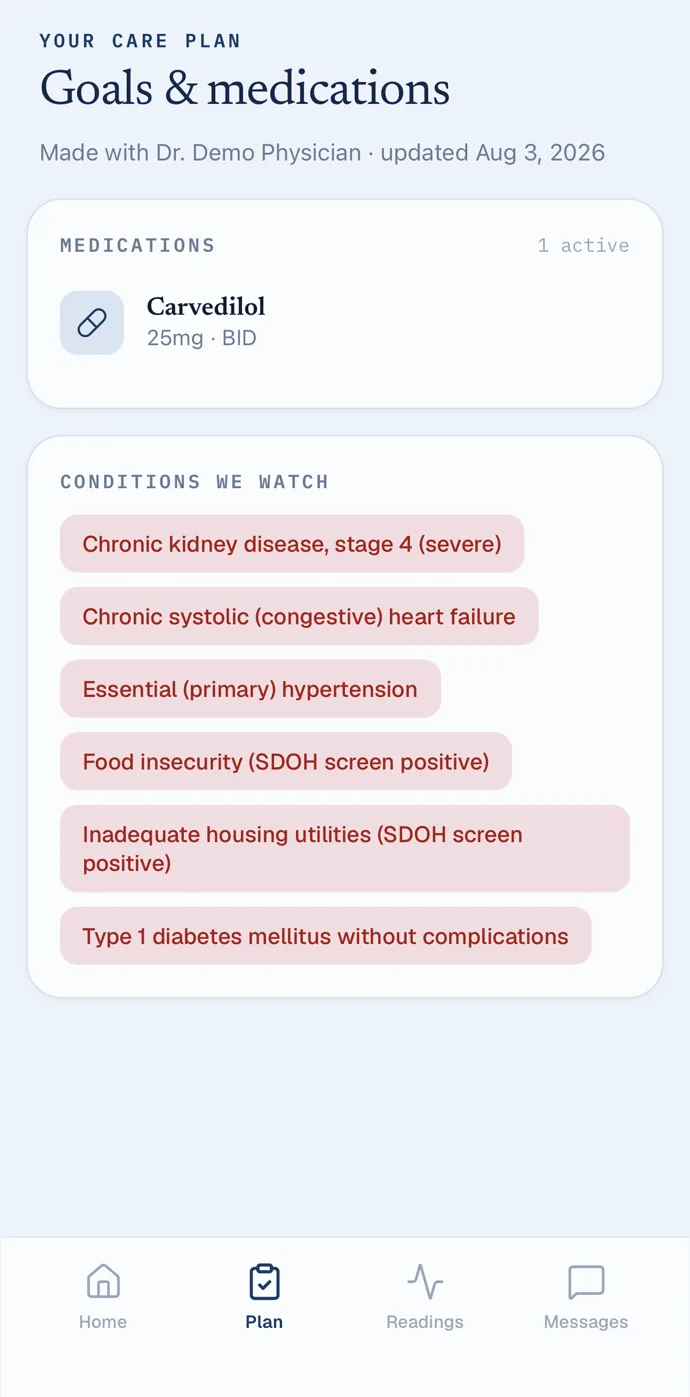
Every enrolled patient gets a private link from your practice. It opens in any phone's web browser, or in the willowbridge app for iPhone and Android. The first time, they confirm their date of birth and choose a four-digit PIN. After that they sign in with the PIN, and the app stays locked behind Face ID or a fingerprint. No password to forget, and nothing a 78-year-old has to install. It shows the goals you agreed on and the team behind them by name, and in the browser it can ask them questions between visits.
Plain-language goals
The same goals you set in the care plan — rewritten in the patient's voice, with "why this matters" sourced from the clinical record.
Send a questionnaire without a visit
Push a PHQ-9, GAD-7, or PEG to the patient's portal from the chart. It appears at the top of their page marked “Your care team asked for this,” scores itself the moment they finish, and lands back on your worklist. The ask reminds itself for three weeks, then stops — because at that point it's a phone call, not another notification.
A safety net that doesn't depend on someone reading the score
A positive PHQ-9 item 9 chains straight into a C-SSRS and raises a flag that stays up until a clinician clears it. The instrument you sent at 9pm on a Friday does not sit unread in a queue.
The daughter your team should know about
From the app, a patient can add a family member to their care team with a one-time code, so your team knows who they are and how to reach them — without sharing anything from the health record.
Check-ins your team can't miss
A one-tap "how are you today" lands in a dedicated From your patients queue — not buried in a log. willowbridge also watches the pattern: a patient who checked in every week for a month and then went quiet gets surfaced, and so does one whose answers just broke a good trend.
Patients who add the willowbridge app also get an appointment nudge the day before, and a “welcome home” note when your team opens a transitional-care episode after a hospital stay, reminding them they can request a call from the app. Care-team notifications never name a condition, a medication, or an instrument — they have to be safe on a lock screen someone else might see.
willowbridge
Riverbend Family Medicine
HELLO EDITH · MAY 2026
Your plan for taking good care this season.
Three goals, five medications, one team — kept up to date after every visit.
YOUR TEAM
DV
Diego Velasquez, MD
Your primary care provider
MA
Maya Aoki, RN
Your navigator — call anytime
SP
Sara Pinkham, PharmD
For medication questions
THIS SEASON'S GOALS
1
Bring blood pressure under 135/80 by July
Target: average 7-day reading
2
Daily weights, call if up 3 lb in 2 days
For your heart failure
How are you today?
A quick check-in helps Maya keep things current.
Mobile apps · iPhone and Android
Two apps. One care plan.
willowbridge puts the plan on your patient's phone; willowbridge care puts the worklist, the chart and the timer in your team's pocket. Both are free, and both work from the same record.
willowbridge
For patients
The care plan you agreed on, in plain view
Readings from the home devices you provide, and a personal CGM if they choose to share it
A two-tap check-in and a secure line to the care team
Screens captured in a demo practice with synthetic patients. Apple, the Apple logo, iPhone and App Store are trademarks of Apple Inc. Google Play and the Google Play logo are trademarks of Google LLC. Android is a trademark of Google LLC.
The economics
What you're already eligible for. What you're leaving on the table.
Every program bills on its own: APCM or CCM each month, RPM every 30-day cycle, BHI on top of either. Drop your numbers in. The model starts from 2026 Medicare national rates, and every rate is yours to change.
The Medicare panel you have today.
Adjust the numbers to your practice. The breakdown updates as you type.
Program% of enrolled$ / month
APCMG0557 · Level 2
CCM99490
RPM99454 + 99457
BHI99484 · G0570
APCM and CCM can't both bill for the same patient, so together they top out at 100% of enrolled patients. CCM is counted as the remainder.
Defaults: 500 Medicare patients, 90% of them enrolled in at least one program. Every Medicare patient who gets primary care from you can qualify for APCM, at Level 1 with one chronic condition or none. APCM and CCM never bill for the same patient, so their shares add up to 100% at most; RPM and BHI stack on either. Rates are 2026 Medicare national averages, rounded: APCM at Level 2 (Level 1 pays about $16, Level 3 about $117), CCM's first 20 minutes, RPM's device and first 20 minutes, and BHI (G0570 when it rides on APCM). Your locality pays differently; type your own.
Patients enrolled450
Program enrollments540
APCM · 360 patients$209,952/yr
CCM · 90 patients$64,152/yr
RPM · 45 patients$50,544/yr
BHI · 45 patients$27,702/yr
Billable program-months a month486
Monthly captured revenue$29,363
Annual captured revenue$352,350
A month that misses its time or documentation requirement doesn't bill. An RPM 30-day cycle counts as a month here. Already billing some of these programs? Talk to us and we'll model the lift from what you capture today.
Case study №1
A month in the life — Monday morning to a settled claim.
One worklist, two RN navigators, ~1,500 Medicare patients — followed for a full month, all the way through a clean audit. Names and dollar amounts are illustrative; the workflow, billing rules, and evidence requirements are exactly what every willowbridge tenant uses.
Performance-based pricing. You pay for the care you capture.
Most care-management vendors charge a five-figure implementation fee, a per-provider license, and a per-patient PMPM whether or not you ever bill. willowbridge charges none of that. There's one fee, and it applies only to billable care you actually capture.
No implementation
$0
No setup or onboarding fees. We get your practice live — patients, programs, and workflow — at no upfront cost.
No per-provider fee
$0
No seat licenses. Add every clinician, navigator, and biller on your team — the price doesn't change.
No per-patient base
$0
No PMPM and no monthly minimum. You're never billed for a patient who isn't generating billable care this month.
The one fee: $6 per patient, per program, per billable month. One flat charge per program bundle, whichever of its codes bill, and only in a month that closes with a billable service — no qualifying care, no charge. RPM, RTM and CGM count per 30-day monitoring cycle. The rate is fixed for your initial term, and either side can walk away in the first 120 days after go-live.
Remote monitoring devices are sold at the manufacturer's published list price with no markup — a one-time device and shipping charge, plus a flat monthly connectivity fee for each active device — and invoiced separately from the platform fee. A device is your practice's property once it is invoiced.
athenahealth Marketplace
Built for athenaOne. Listed on the athenahealth Marketplace.
willowbridge is purpose-built for athenahealth practices. Sign in once with your athenaOne login, connect willowbridge from the athenahealth Marketplace, and your care-management team works the panel from one worklist. Notes land in the chart on the date of service. Charges hand off to athenaOne's billing pipeline as structured charge entries — no separate clearinghouse, no PDF shuffle, no new biller to train. Your existing athenaOne workflows for revenue, payments, and reconciliation stay exactly where they are.
athenaOne-native, standards-based
willowbridge connects directly to athenaOne. Authentication is athenahealth's SMART on FHIR OAuth. Clinical reads are FHIR R4 (US Core) — problems, medications, encounters, coverage, labs, immunizations, care team. Clinical writes ride athenaOne's own document, vitals, and charge APIs, because that is what athenaOne actually exposes for writing, and it is the only way a note lands as a real chart document rather than an attachment nobody can find. Device readings flow in through whichever cellular hub or phone-bridged health store the patient already uses — nothing new for them to set up.
If a vendor tells you they write your chart over FHIR, ask which create scopes their EHR granted them. Most read/search-only FHIR servers grant none.
What flows to athenaOne
athenaOne owns the bill. willowbridge owns the proof.
DocumentReferenceSigned encounter notes, care plans, ACP attestations, RPM measurement summaries, and SDOH screening results land in the chart attached to the date of service — as native chart documents, filed under the right document class, not loose PDFs in a folder.
Charge entryStructured charges (CPT, units, dx pointers, rendering provider, place of service) handed to athenaOne at sign-off. athenaOne bills the payer through your existing setup.
Care planThe current, versioned care plan filed into the chart on every amendment, so a covering provider who never opens willowbridge still sees the plan your team is working from.
VitalsRPM device readings posted into the chart's vitals as discrete, dated values — graphable next to office readings, not stranded in a monitoring portal.
Reads (FHIR R4)Problems, medications, encounters, coverage, labs, allergies, immunizations, and care team pulled on chart open, so your navigator is never working from a stale copy.
willowbridge is generally available on the athenahealth Marketplace. Production rollout is per-practice as the matching SMART scopes are enabled on your athenaOne tenant.
Security & compliance
The boring infrastructure that lets you sleep at night.
A signed BAA is in place before any patient data touches the system. The encryption, tenant isolation, and audit log below are built to hold up under an actual payer audit — not just to look right in a security questionnaire.
Encryption at rest
A stolen backup reads as noise.
Patient data is AES-256-GCM encrypted on disk, with keys managed by AWS KMS.
Tamper-evident audit log
Nobody — including us — can quietly edit history.
Every read and write lands in an append-only log, hash-chained so tampering shows.
Tenant isolation
Your practice’s data lives behind its own wall.
Records are walled off at the database itself, not just in the application code.
U.S.-hosted
U.S.-hosted, U.S.-processed.
Runs in a U.S. AWS region, and no offshore processor ever touches patient data.
Common questions
Questions practices ask first.
Who actually bills the claim — athenaOne or willowbridge?
athenaOne bills. willowbridge produces the structured charge (CPT, units, dx pointers, rendering provider, place of service) at sign-off and hands it to athenaOne's charge API. From there it goes through your existing athenaOne billing setup — same payer connections, same posting, same reconciliation. No new clearinghouse, no new biller to train, no PDF shuffle between systems. Reimbursement lands in your account, where it already does.
How is the time substantiated if it's spread across multiple staff in one month?
Every encounter is stamped with the performing staff member, their role, the activity type (phone call, chart review, secure message, medication reconciliation, patient education), the patient, and start/end timestamps. The chronological log is append-only and hash-chained. At month-end, the rendering provider reviews the billing period and signs an attestation that includes the CMS-required general-supervision affirmation; the signature is cryptographically bound to the period (Ed25519, per-provider key) so a payer can independently verify it later. The cumulative minutes lock to that signature — nothing edits the period after approval.
What does an audit response actually look like?
One click on the billing period builds a single paginated PDF: cover sheet, eligibility, patient consent, the care plan pinned to the date of service, the chronological time log, the signed clinical note, and the provider attestation. That's the document you fax or upload to your MAC for an ADR or TPE — no unzipping, no assembling loose files. It's drawn from the snapshot frozen the moment the period was signed, so it can't drift from what athenaOne billed on your behalf. The same records also come as a verifiable archive — every file fingerprinted into a signed manifest, with an open-source verifier (packages/audit-verify) — for the rare payer or auditor who wants to confirm the chain themselves. The audit packet (the work) and athenaOne's claim + 835 (the bill) cross-reference cleanly by patient + date of service + CPT.
How long does implementation take?
It runs in a fixed order. The agreements and the BAA are signed first — no patient information enters willowbridge before the BAA is in place. Your practice then authorizes the connection from the athenahealth Marketplace, your staff accounts are set up with multi-factor authentication, and your billing providers are added. In the first week your team consents patients and builds their care plans, and the first billable month closes at the end of your first full calendar month on willowbridge. There's no clearinghouse onboarding, no SFTP credentials and no 837 mapping: charges hand off to athenaOne's own billing.
Can we run CCM, RPM, BHI, and TCM on the same patient?
Yes, within the rules willowbridge enforces when the month closes. APCM and CCM never bill on the same patient. CCM and PCM don't bill under the same practitioner in the same month, and two practitioners can't both bill them for the same condition; APCM and PCM don't bill under the same practitioner either. Minutes logged inside a TCM episode's 30-day window belong to TCM, not to CCM or PCM. APCM and TCM don't bill in the same month under the same practitioner. RPM and RTM are exclusive. RPM pairs with CCM or APCM as long as no minute is counted twice. General BHI stacks on APCM through the APCM behavioral-health add-on, G0570. When home-health care-plan oversight and a care-management month collide, the one with the higher Medicare allowable bills. The worklist tells your team which program any given encounter is contributing to before the encounter starts.
What about FQHCs and rural health clinics?
Yes. CMS retired G0511 for FQHC and RHC care coordination: from January 1, 2025 FQHCs and RHCs bill the individual care-management codes, and the transition that let them keep billing G0511 ended September 30, 2025. FQHCs and RHCs now bill the standard care-management codes directly (99490 / 99491 / 99487 CCM, 99424–99427 PCM, 99484 BHI, 99457/99458 RPM). willowbridge runs the same workflow your non-FQHC peers use; each code is paid at the national non-facility PFS rate, separately from your PPS / AIR encounter rate, the way the bundled code was.
What does it cost?
$6 per patient, per program, per billable month — and nothing else. There's no setup or implementation fee, no per-provider license, no per-patient base fee, and no monthly minimum. The charge applies only when a patient qualifies for a billable service and the month closes; if a patient doesn't qualify that month, there's no charge. It's one flat fee per program however many of its codes bill, so nothing on our side rewards up-coding, and we don't take a cut of your reimbursement or charge for the audit packet. The rate is fixed for your initial term, and either side can walk away in the first 120 days after go-live. Remote monitoring devices are the one separate line: sold at the manufacturer's published list price with no markup — a one-time device and shipping charge plus a flat monthly connectivity fee per active device — and invoiced apart from the platform fee. Reach out for a walkthrough sized to your panel.
Who actually does the day-to-day work?
One staff member working a list — typically an RN or medical assistant acting as the care navigator, part-time at the start and scaling with the panel. The physician appears twice per patient per month: once at enrollment to obtain and document consent, and once at month-end to review the billing period and sign the attestation. Everything in between — outreach calls, chart review, medication reconciliation, care-plan updates, device monitoring, patient messages — is designed for non-physician staff working from a prioritized worklist rather than from a report someone has to interpret. In a solo practice where the owner is also the office manager, both roles sit on a single login.
What happens to our data if we leave?
You keep it, and most of it never left your building in the first place. Signed notes, care plans, vitals, and charges are written into athenaOne as they happen — so your system of record stays complete whether or not willowbridge is still in the picture. On top of that, the product exports a patient's full record as a USCDI v3 FHIR bundle, as C-CDA documents, or as PDFs, and a complete tenant export — clinical records, the chronological time log, and every signed audit packet — is produced at offboarding. Nothing about the design requires you to keep paying us to read your own charts.
Does the CY 2027 proposal on remote monitoring staffing affect us?
It depends on how you run RPM today. In the CY 2027 Medicare Physician Fee Schedule proposed rule (CMS-1848-P), CMS proposed that clinical staff time count toward a billable RPM or RTM service only when the staff member is employed by the billing practitioner or the practice, under general supervision — so time furnished by a contracted third-party monitoring company's staff would no longer be billable. If you use a full-service vendor that supplies the monitoring staff, that model is what the proposal targets. If your own employed staff do the monitoring, nothing changes for you: willowbridge is software your staff sign into, not a service that supplies staff, so there is no call center working your panel under your NPI. The proposal would not stop you buying devices or software from a vendor, and it does not reach CCM, PCM, BHI, or APCM. Worth stressing: this is proposed, not final. The comment period closed September 14, 2026, and the final rule is expected around November 1, 2026; CMS may finalize the provision as written, modify it, or decline to finalize it — so treat it as something to plan around, not a deadline. Information as of October 9, 2026; not legal or reimbursement advice.
Book a demo
See willowbridge in action. 20 minutes, no prep required.
A live walkthrough with a willowbridge clinical lead. We'll show you the worklist, the audit packet, and the billing flow on a demo tenant — no data of yours, no setup on your end. Bring your questions about programs, workflow, or fit.
Got it
Thanks — we'll be in touch within one business day.
A willowbridge clinical lead will reach out to schedule your 20-minute walkthrough. No setup needed on your end.