One month at a primary care practice, screen by screen.
Follow a care team through one calendar month in willowbridge: the morning schedule, adding and enrolling patients, consent and the care plan, the hospital discharge sweep and TCM, home health certifications, logging time, a remote monitoring alert, a PHQ-9 for behavioral health, population health, the care app, and then month end, when the provider signs and the claims go to athenaOne and are paid.
The practice is a composite. Every screen below is a real willowbridge screen, taken from our demo practice, whose patients and staff are invented. No real patient appears on this page.
Set up the month.
The care team starts from one list, sees who is coming in, and brings new patients into the programs they qualify for.
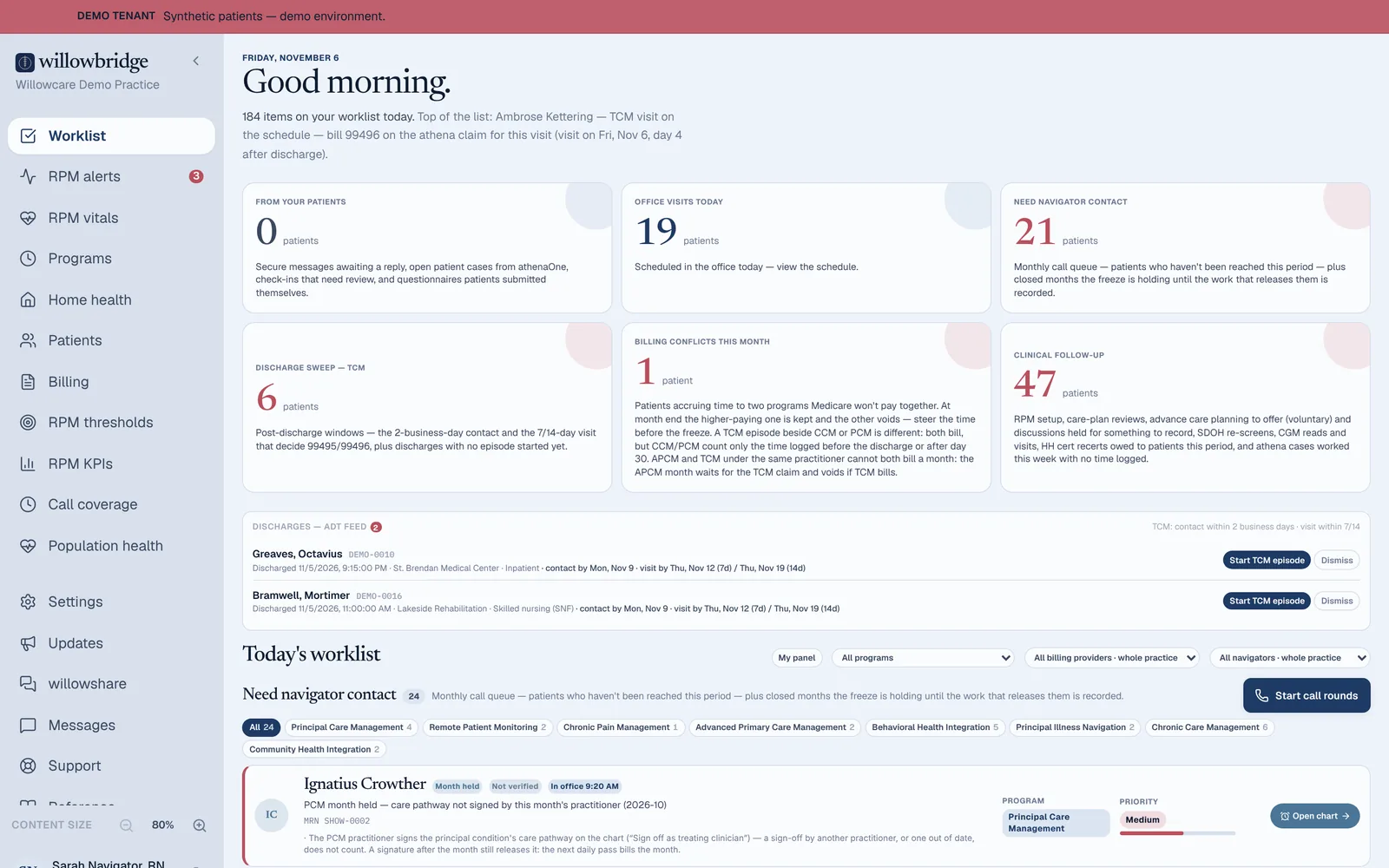
The day starts on the worklist.
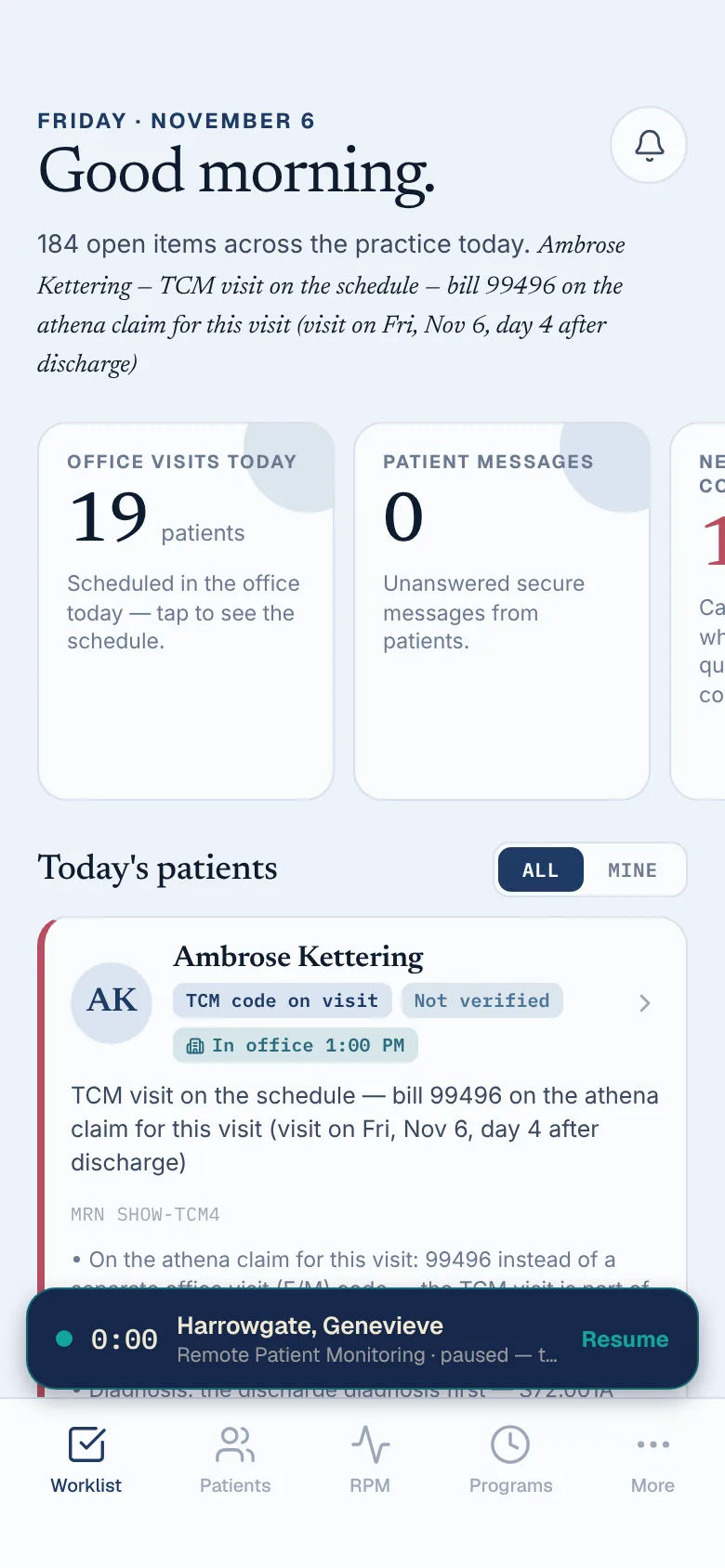
The care manager opens willowbridge to the worklist. At the top: today's office visits, patients who still need this month's call, new discharges from the hospital feed, and clinical follow-ups. Below, every row says what to do for that patient and why, and opens the chart in one click.
- Rows come from every program the patient is in, not one list per program.
- New hospital and nursing facility discharges appear on the worklist with their TCM deadlines.
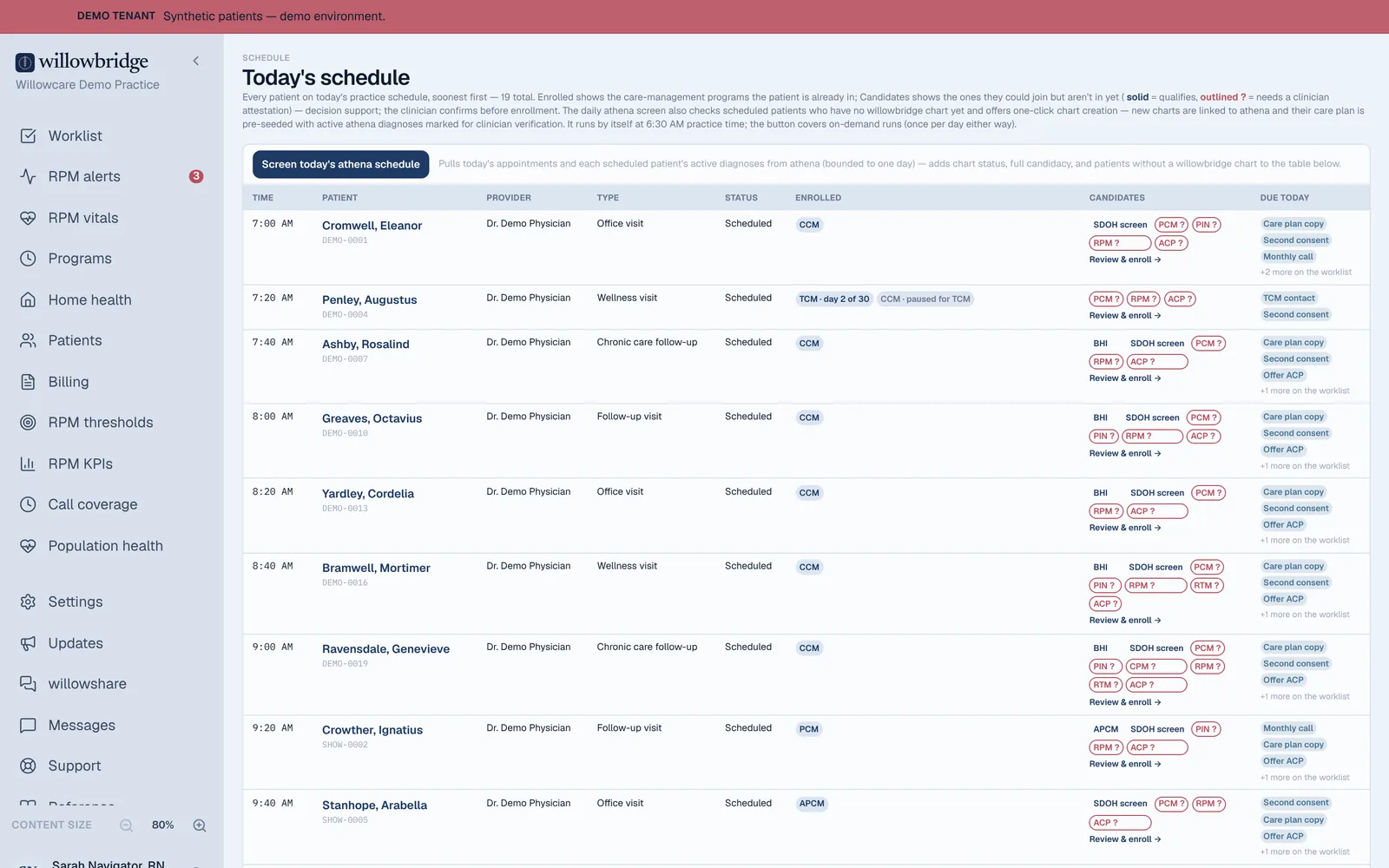
The schedule, with a chip for each program.
willowbridge reads the day's appointments and each patient's active diagnoses from athenaOne. Beside each visit are the programs the patient is already in, the ones they could join, and what is due today, such as a care plan copy or a consent. The provider knows who to offer what before the patient walks in.
- The schedule is screened every morning, and again on demand.
- A solid chip means the patient qualifies; an outlined chip with a question mark needs the clinician to confirm.
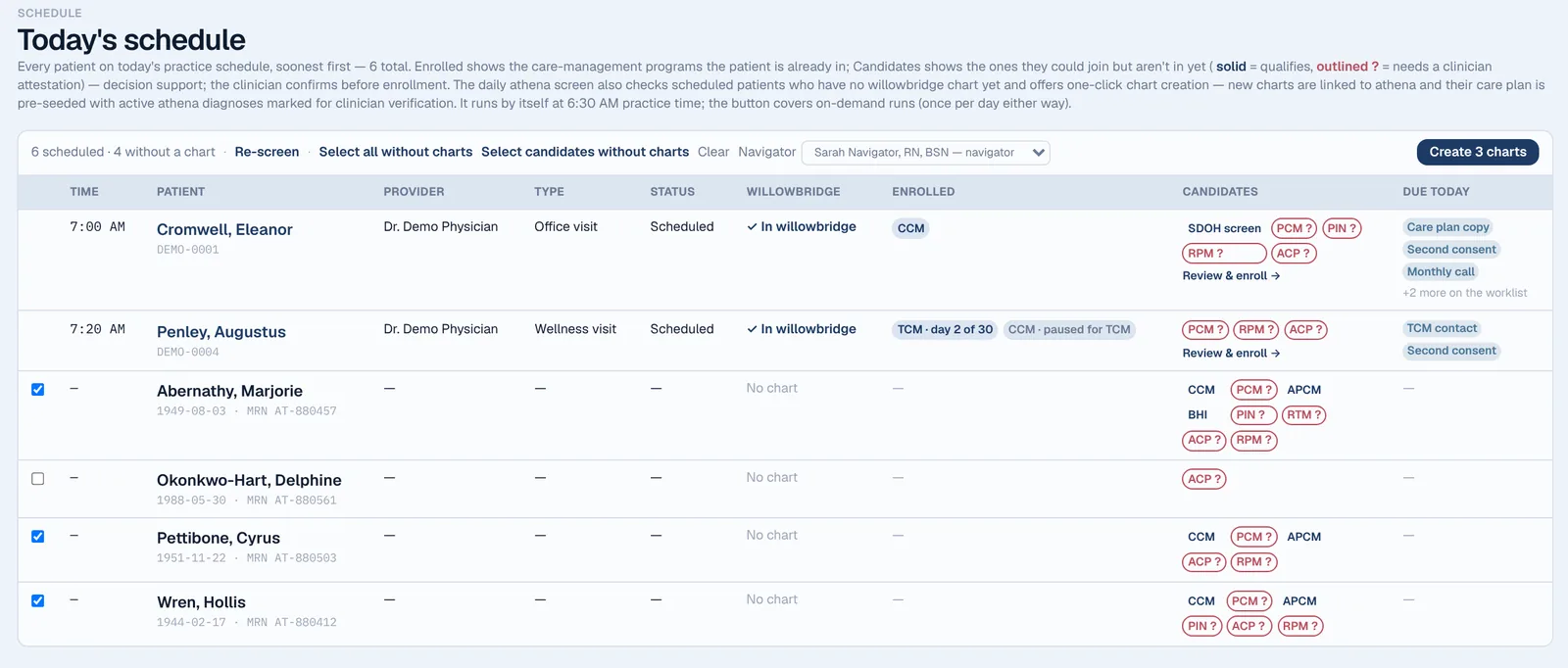
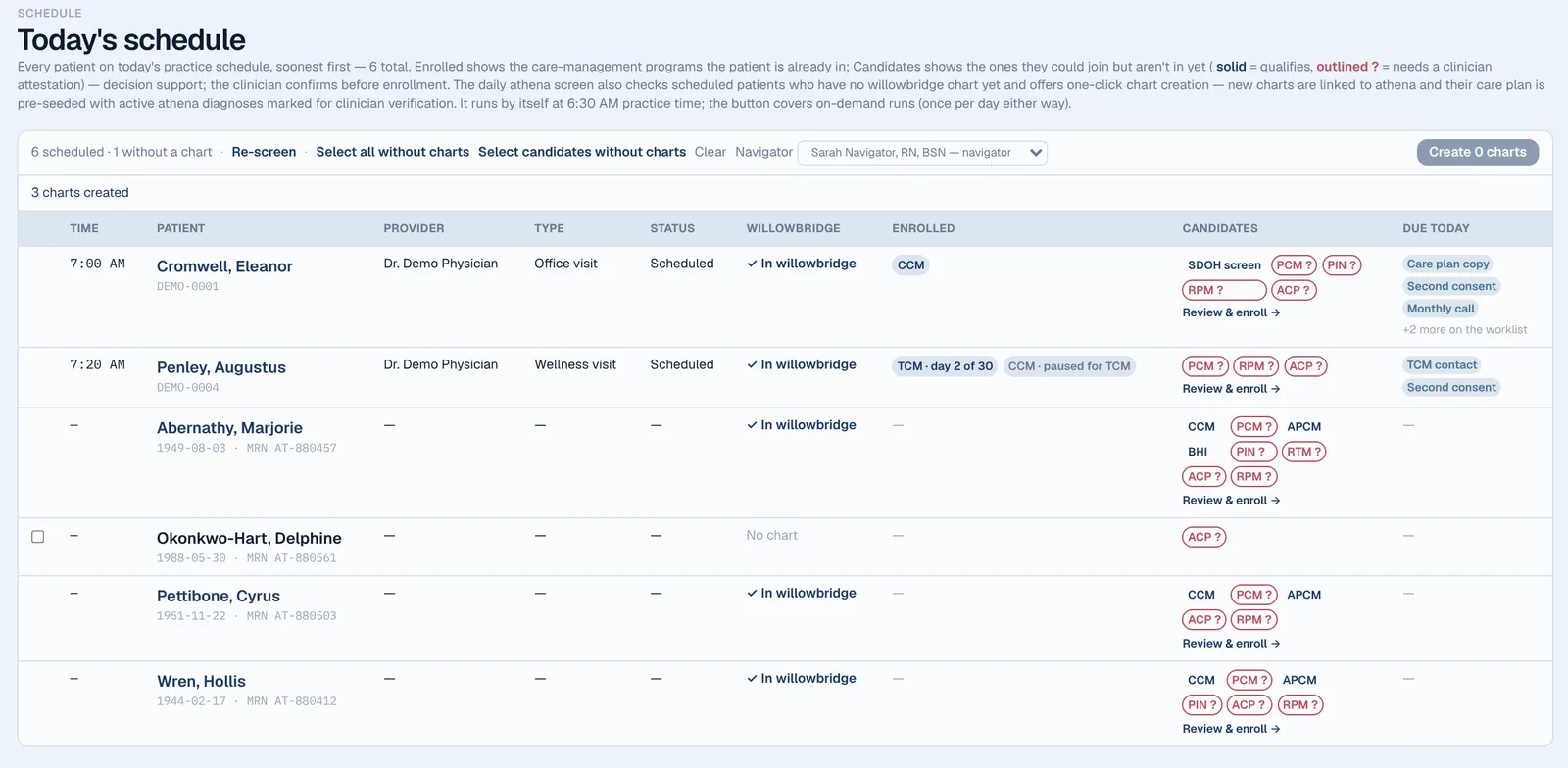
Bringing patients in from athenaOne.
Each morning willowbridge screens the athenaOne schedule. Patients booked today who don't have a willowbridge chart yet appear right on the schedule, with the programs their athenaOne diagnoses suggest. The medical assistant ticks the ones to bring in, picks their navigator, and clicks Create charts. Their demographics, insurance, problem list and medications come across from athenaOne, and a care plan is started from their active diagnoses for the clinician to confirm.
A patient who isn't on today's schedule can be added by hand with an MRN and date of birth, and the rest syncs from athenaOne the first time the chart opens.
- One click creates several charts, each linked to its athenaOne record.
- A possible duplicate is flagged before a second chart is made.
Enrolling in a program.
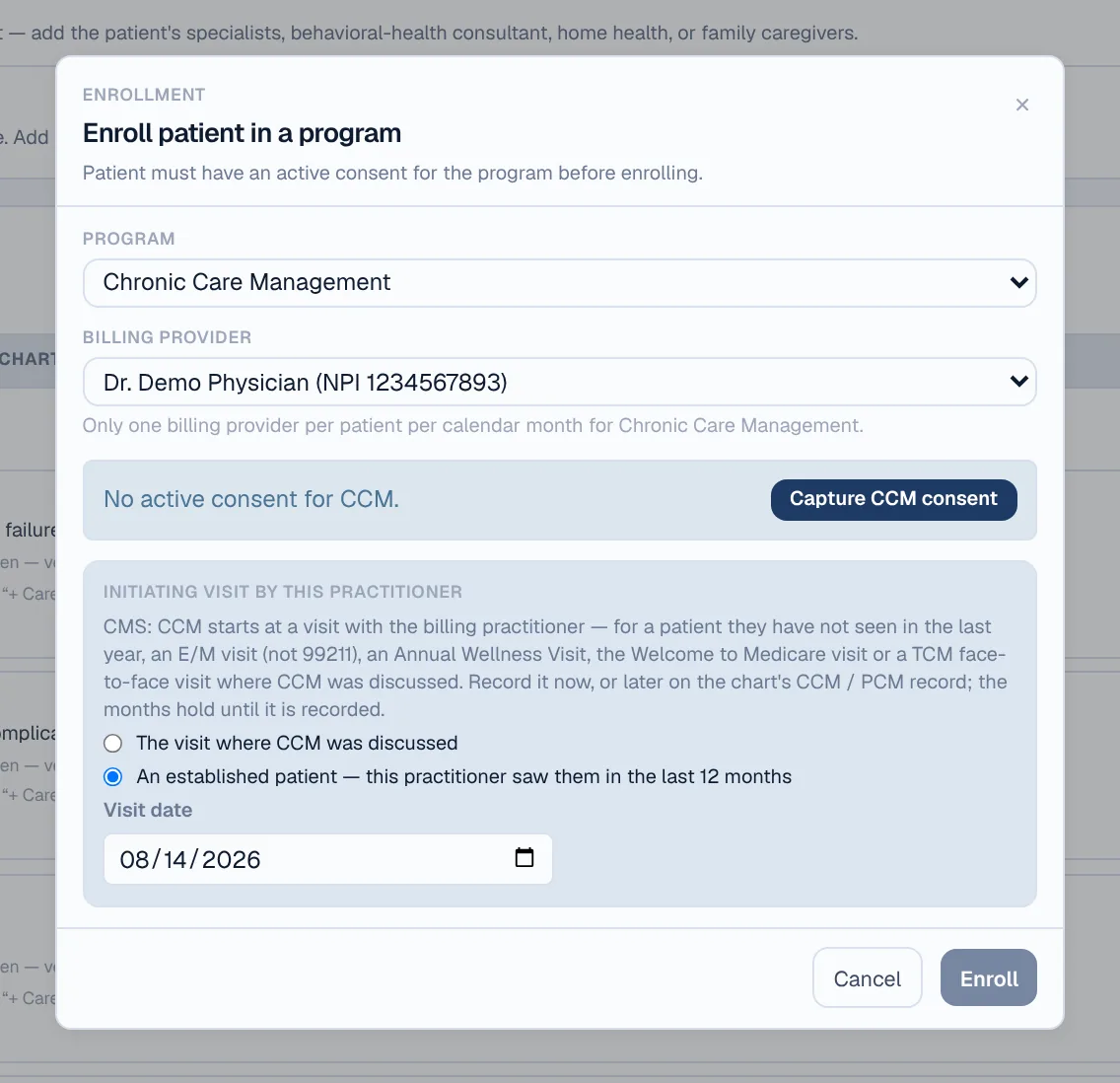
One of the new patients has two chronic conditions. The care manager enrolls her in chronic care management under her physician and records the initiating visit: an established patient seen in the last 12 months. willowbridge won't finish the enrollment until a consent for the program is on file, so the next step is the consent.
- Each program checks its own Medicare rules at enrollment, including the initiating visit.
- Only one billing provider per patient per month, as Medicare requires.
Consent, then the care plan.
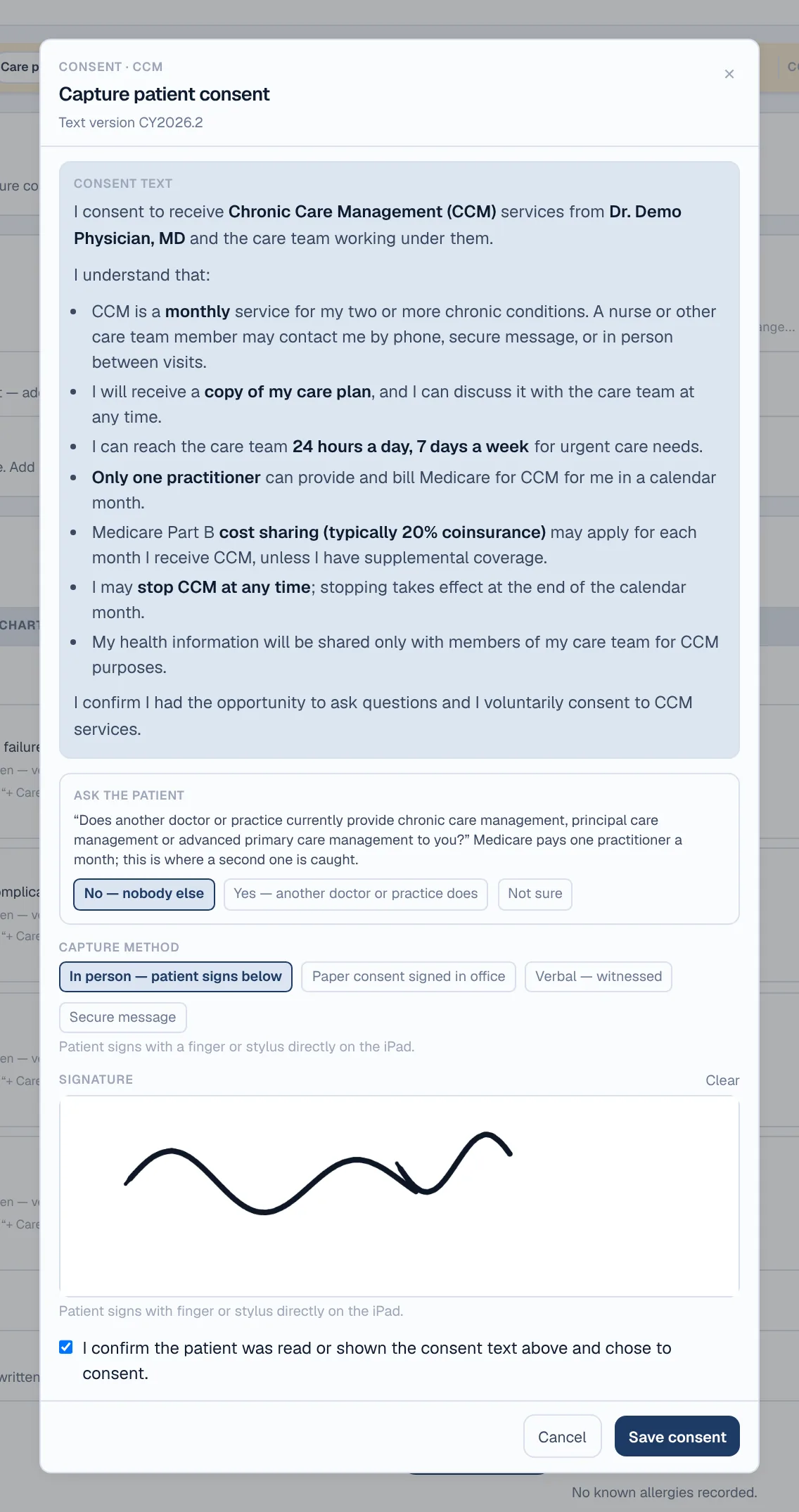
The consent text names her physician and says what CCM is, what it costs, and that she can stop at any time. She reads it on the screen and signs with a finger; it can also be a signed paper form, a witnessed verbal consent, or a secure message. willowbridge asks whether another practice already provides this service, and stores the exact text she agreed to, how, and when.
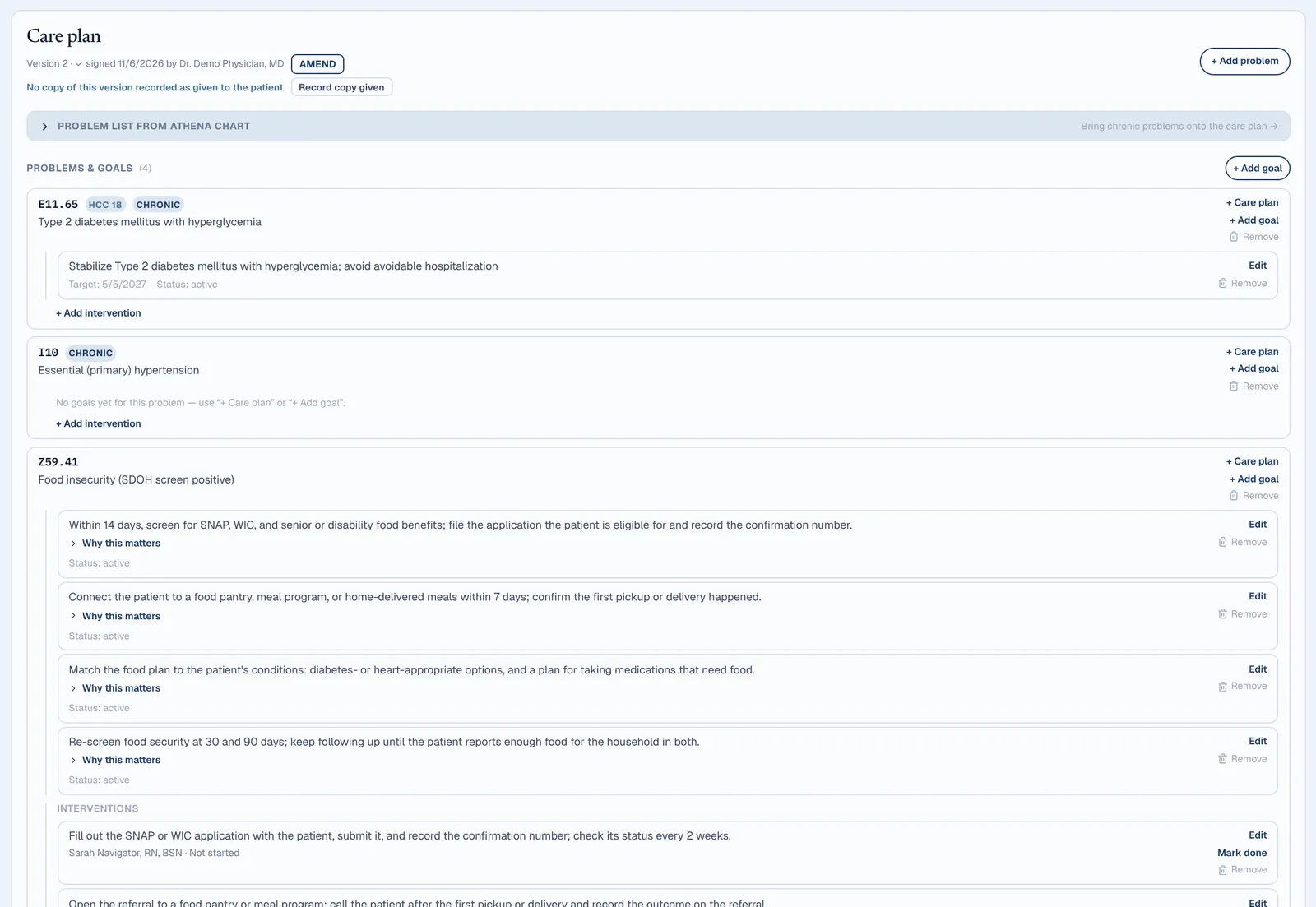
Then the care manager builds the care plan from her athenaOne problem list: problems, goals, and interventions assigned to a member of the team.
- No billable month opens without a consent that covers it.
- Each care plan version is signed by the physician, and the copy given to the patient is recorded.
Catch every transition.
Hospital discharges and home health certifications are where patients and revenue both slip through. willowbridge watches for them.
The discharge sweep.
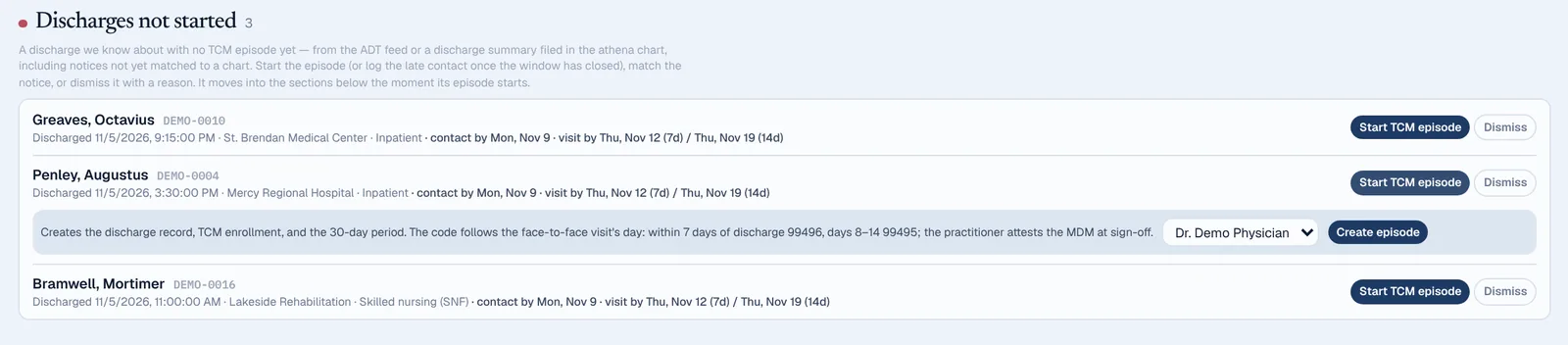
Three patients were discharged yesterday: two from hospitals and one from a skilled nursing facility. willowbridge found them in the hospital admission and discharge feed and in discharge summaries filed in athenaOne. Each one shows the deadline it starts: the first contact within two business days, and the face-to-face visit within 7 or 14 days.
- Discharges are found for the practice; nobody has to remember to look.
- Start the TCM episode in one click, or dismiss the discharge with a reason.
Starting TCM.
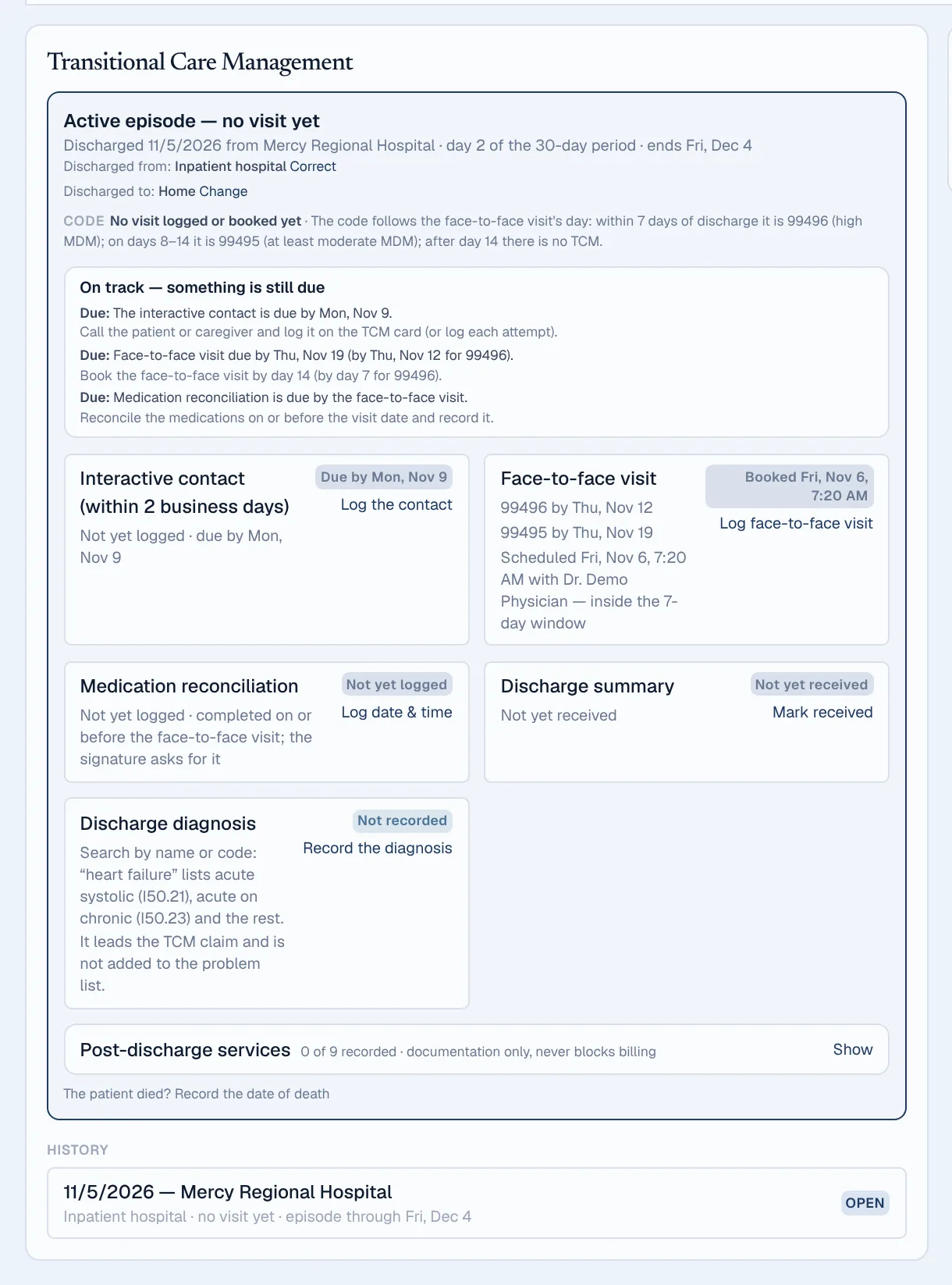
The care manager starts transitional care management for a patient discharged from the hospital. The TCM card lists what Medicare requires, each with its due date: the interactive contact, the face-to-face visit, medication reconciliation, the discharge summary and the discharge diagnosis. The face-to-face visit is already booked on the athenaOne schedule, inside the 7-day window.
- The code follows the visit's day: within 7 days is 99496, days 8 to 14 is 99495.
- Contact attempts are logged with their time, so a missed deadline shows early.
Tracking home health certifications.
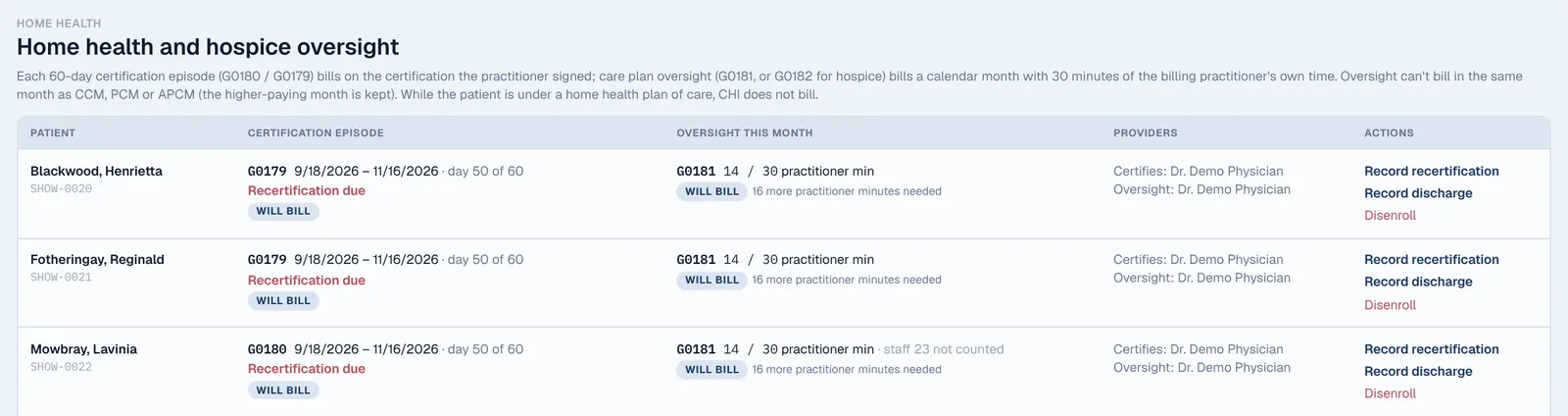
Three patients are under a home health agency's care. willowbridge tracks each 60-day certification period and flags the recertification as it comes due. Beside it are this month's care plan oversight minutes: the provider has 14 of the 30 minutes oversight needs.
- The certification (G0180) and recertification (G0179) bill on the date the provider signed.
- Oversight (G0181) bills a calendar month once the provider's own time reaches 30 minutes.
Do the work, and count it.
Calls, coordination, readings and reviews. willowbridge counts the minutes as they happen, against the right program and the right month.
Adding time to a patient’s case.
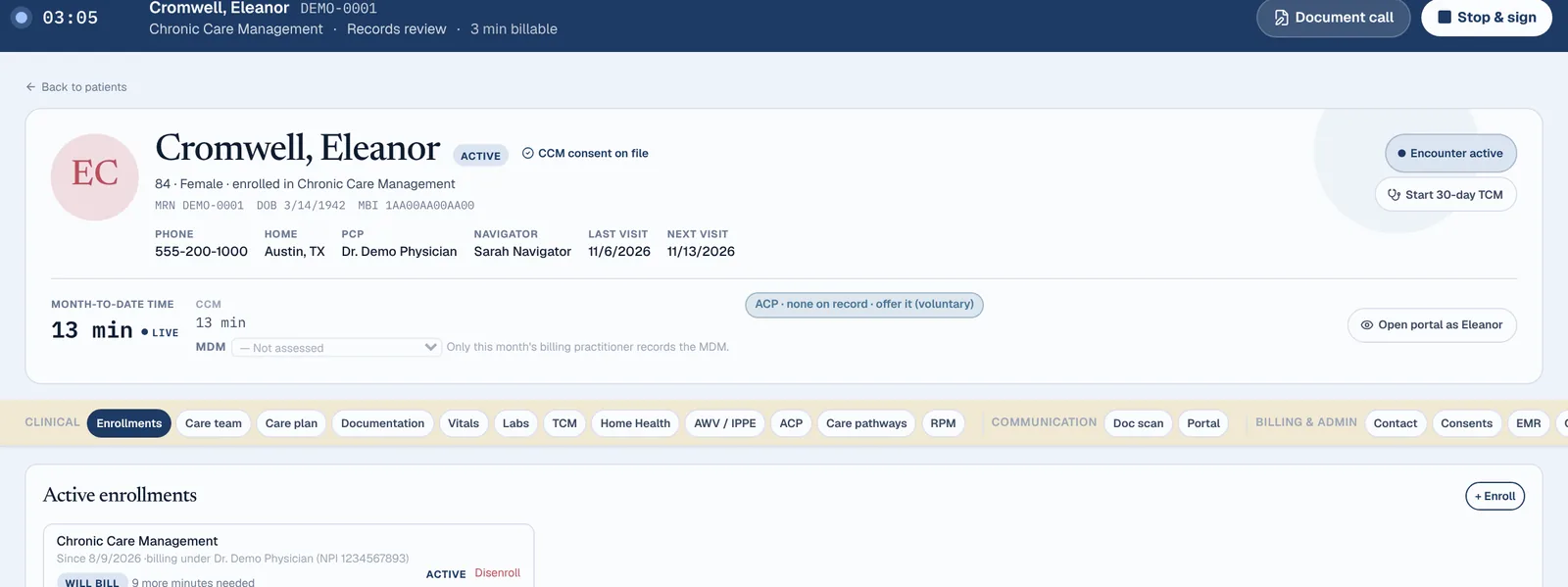
The care manager calls a patient. She starts the timer from the chart, and it follows her across the app; the month's minutes update live.
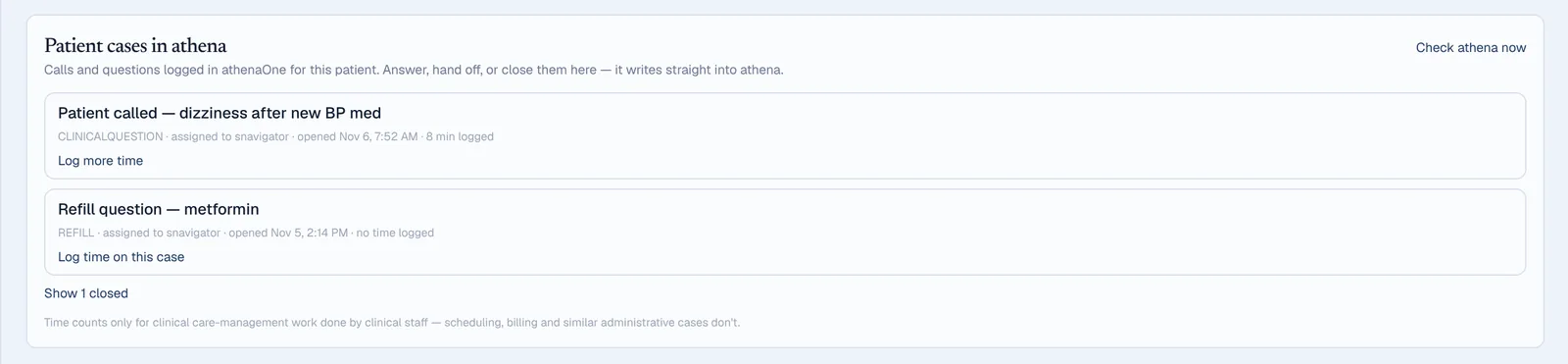
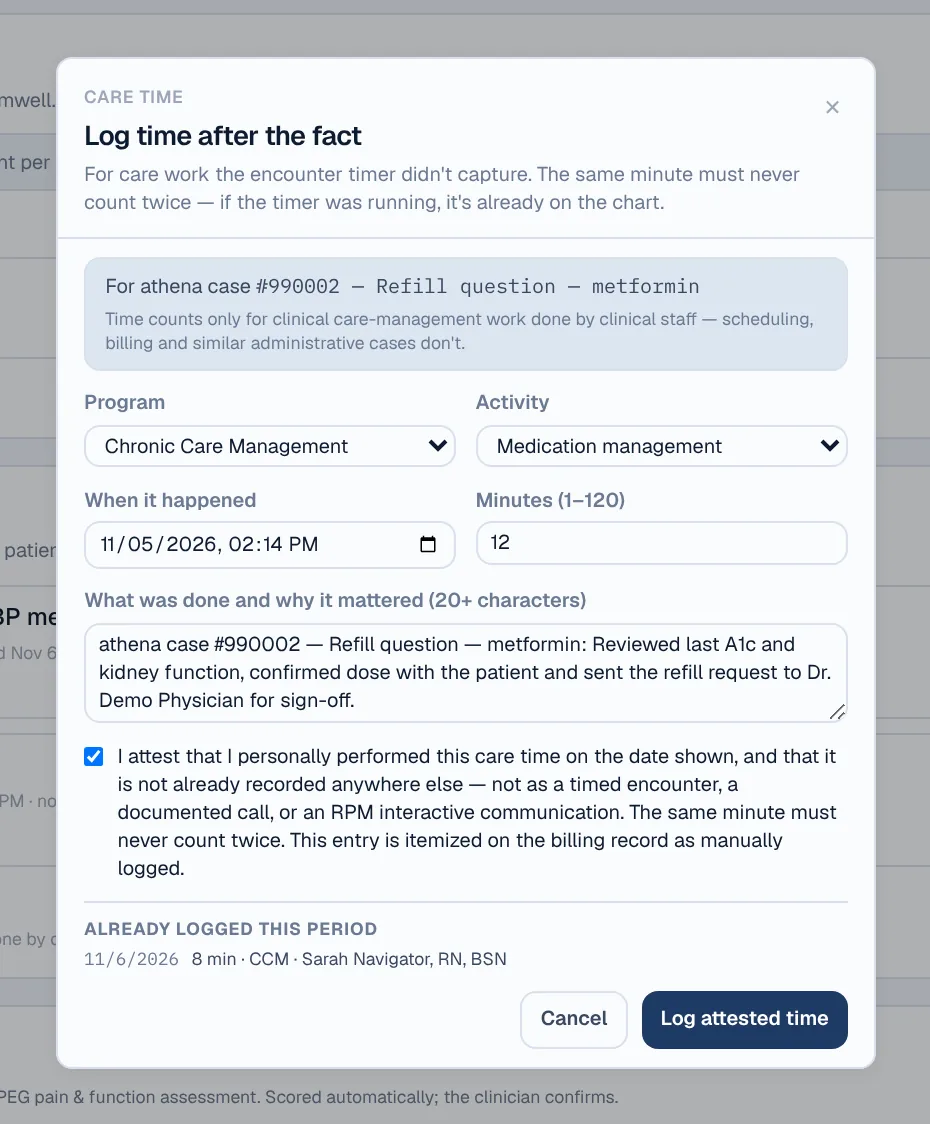
Much of the work happens in athenaOne instead: a patient calls with a question, and athenaOne opens a patient case. Those cases appear on the willowbridge chart. For work already done, Log time on this case opens an after-the-fact entry filled in from the case, with the date, the activity and a note. She types the minutes and attests that the time isn't recorded anywhere else.
- Minutes go to the program they were for, and only count once.
- Each case shows how much time is logged against it, so nothing is logged twice or forgotten.
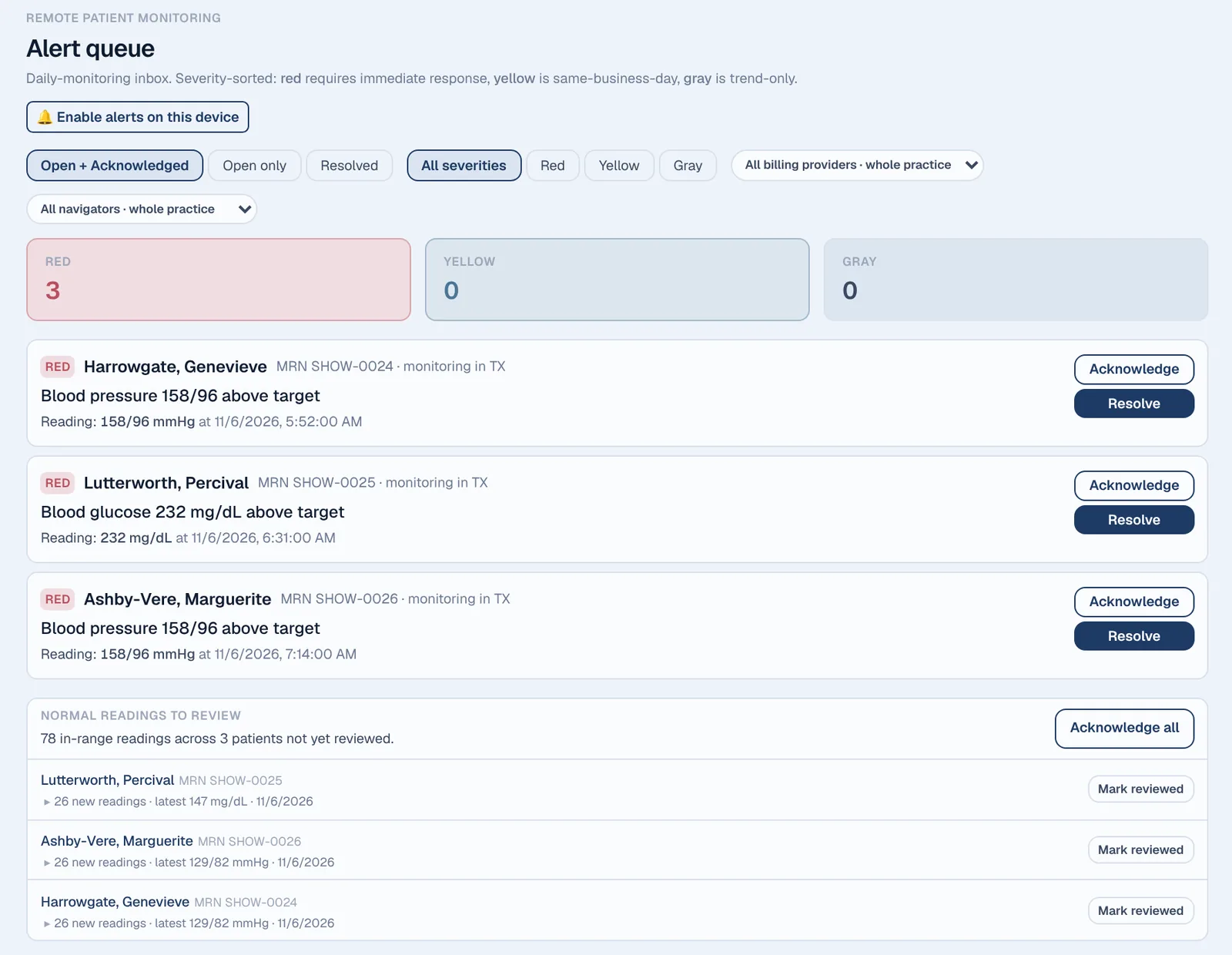
An RPM reading, and an alert.
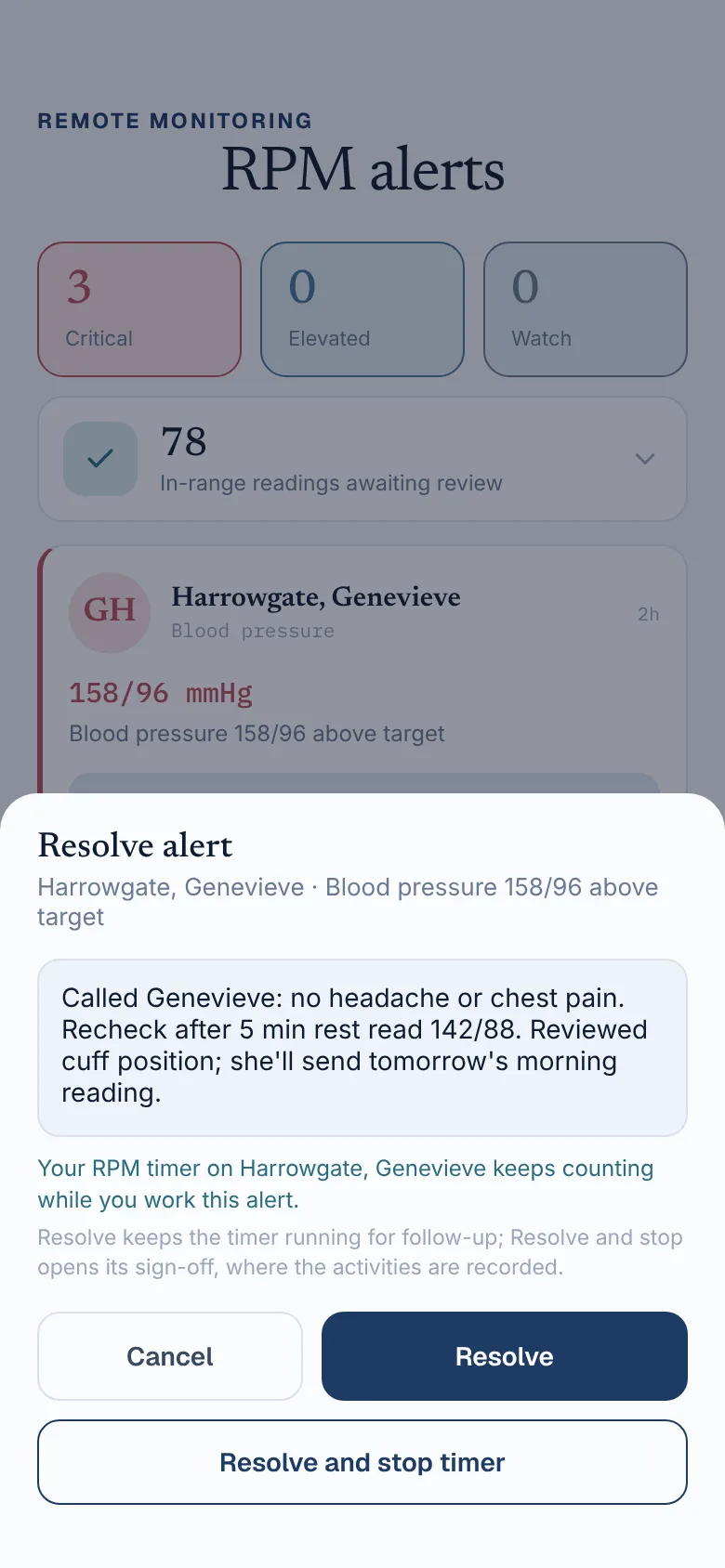
A patient's cellular blood pressure cuff sends 158/96 before breakfast. It is above the target her provider set, so willowbridge raises a red alert. The nurse acknowledges it, calls her, and resolves it with a note. In-range readings wait in their own list to be reviewed together.
- Readings arrive from the device without the patient doing anything extra.
- Each alert records who reviewed it and what was done.
- A month with 10 to 19 minutes of management bills the 10-minute code; 20 minutes or more bills the 20-minute code.
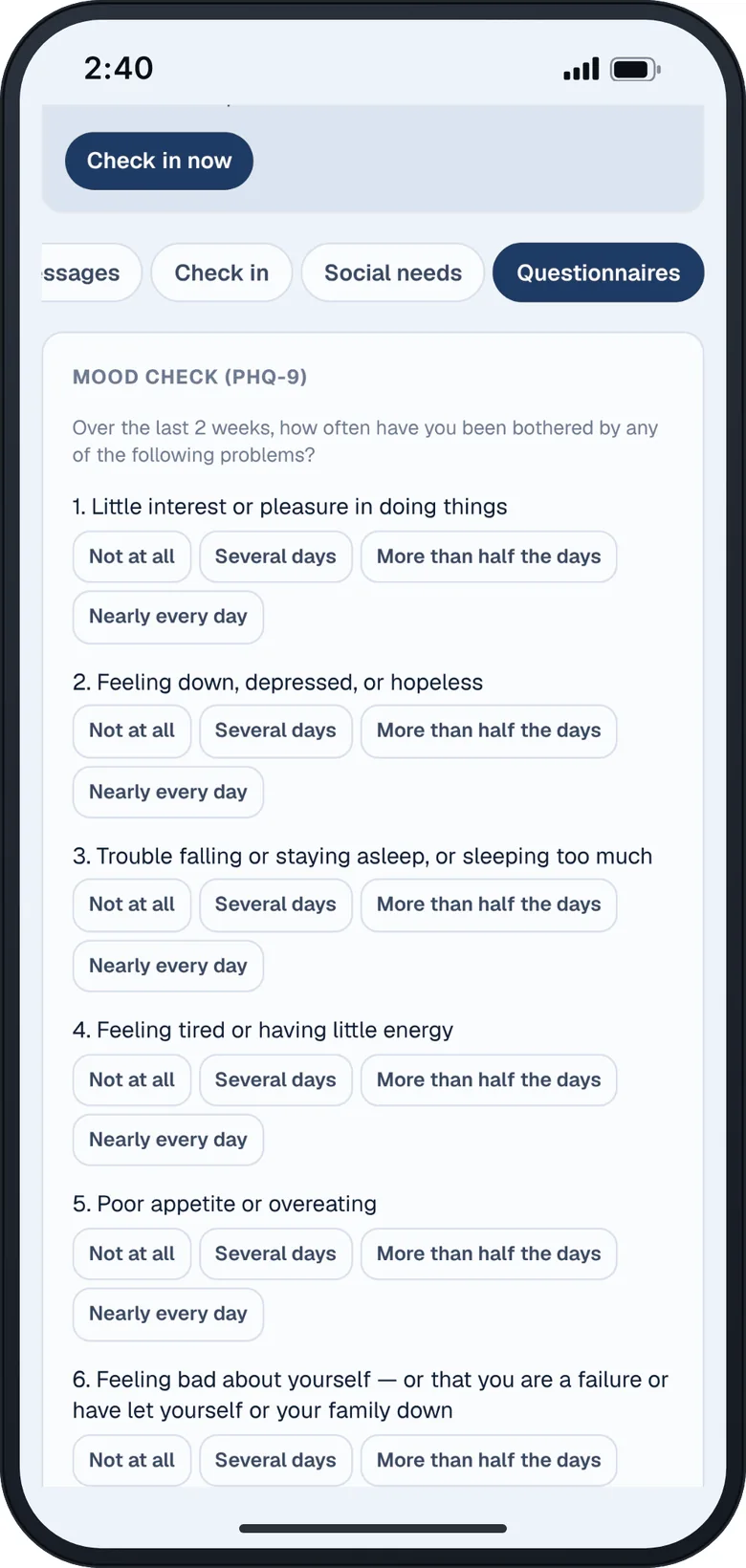
Behavioral health: sending a PHQ-9.
A patient with depression is in behavioral health integration. Before her monthly call, the care manager sends her a PHQ-9 from the chart, with a due date. It arrives in her willowbridge app as a mood check. She answers it on her phone, the score is calculated, and it lands on her chart's trend, ready for the call and for the care plan.
- PHQ-9, GAD-7 and other validated scales, sent to the patient app or given by phone and entered with the date given.
- Behavioral health time is counted separately from chronic care time.

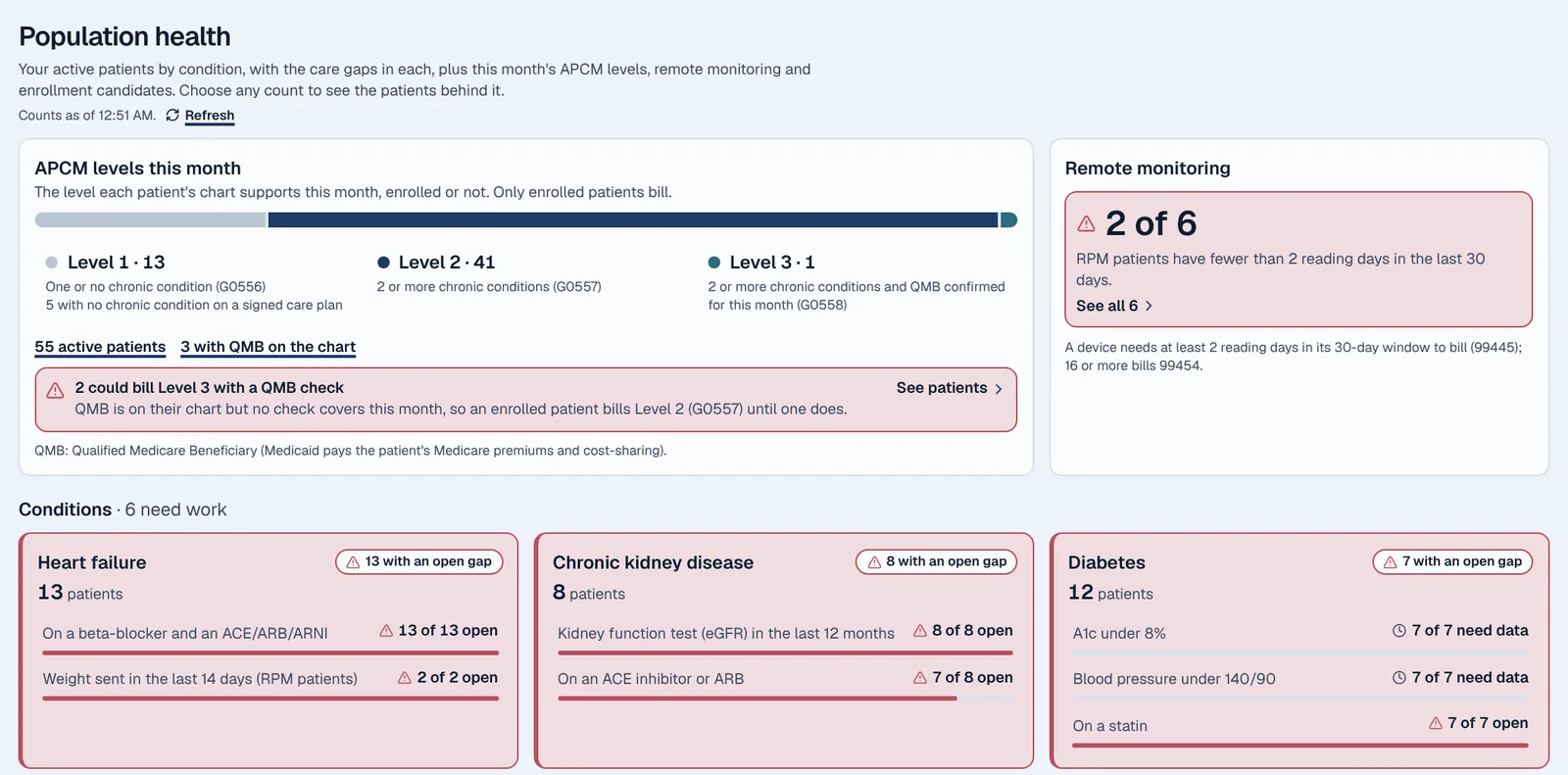
Population health.
The practice manager looks across the whole panel. Population health groups active patients by condition and shows the care gaps in each: heart failure patients not on the recommended medicines, kidney patients due a kidney function test, diabetes patients without a recent A1c. It also shows each patient's APCM level this month and which remote monitoring patients are short of readings.
- Every count opens the list of patients behind it.
- Gaps close as the work is recorded, so the page shows what is left to do.
From the care app.
The nurse is away from her desk. On her phone, willowbridge care shows the same worklist and the same alert. She resolves the alert with a note about the call, and her RPM timer keeps counting while she works it. Providers sign the month from the same app.
- The worklist, chart, timer, alerts and sign-off, on iPhone and Android.
- Patients have their own app for readings, check-ins and the care plan.
Sign, send, get paid.
On the first of the month willowbridge closes the month just ended. What met Medicare's rules is ready to sign. What did not is held, with the reason.
The month closes.
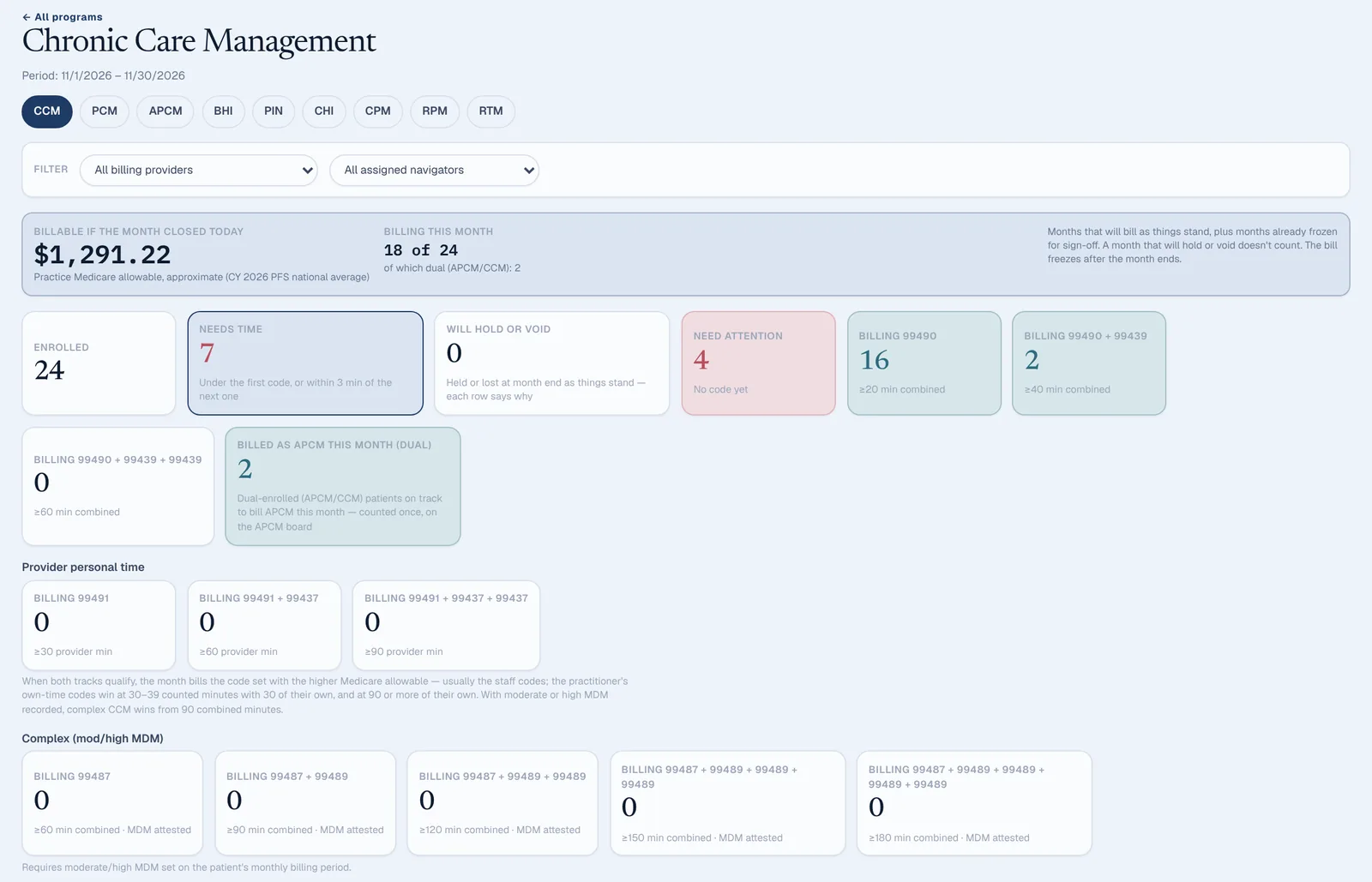
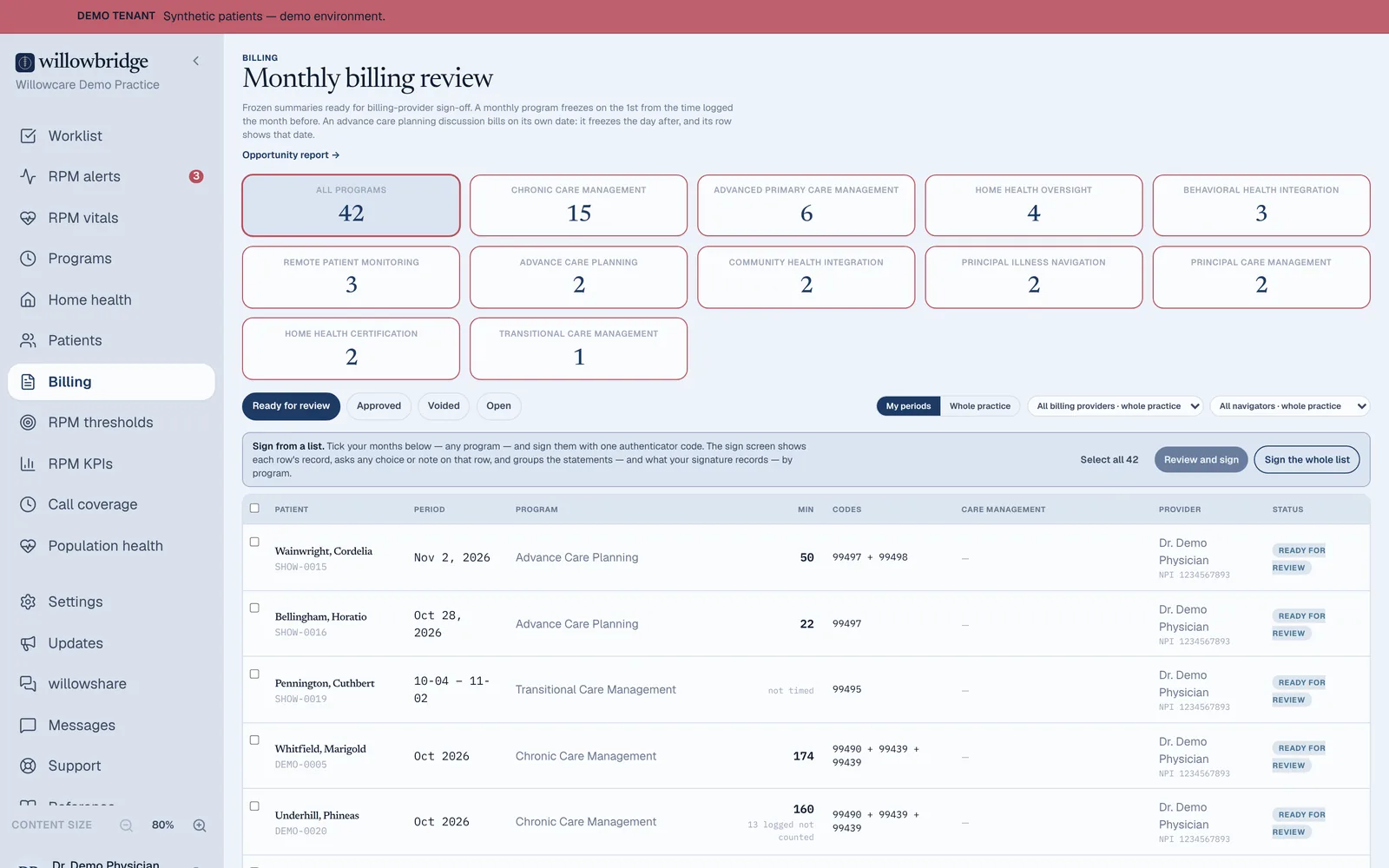
All month, each program's board showed what would bill if the month closed that day, who still needed time, and what would be held. On the first, willowbridge freezes each patient's month in each program: the minutes, the consent, the care plan, the visit. The billing review lists every month ready for the provider, by program.
- Nothing is billed that the record does not support.
- A month that misses a threshold is held with its reason, never padded.
The provider signs off.
The provider reviews each month before it is billed: the codes, the minutes and who spent them, and the statements Medicare requires the provider to attest to. A month can be signed on its own or together with others from a list, on the web or in the care app. Nothing goes to athenaOne without a signature.
- Each signed month keeps its own record of what was shown and when.
- A provider can open any record first, add a note, or leave a month out.
Claims to athenaOne, then paid.
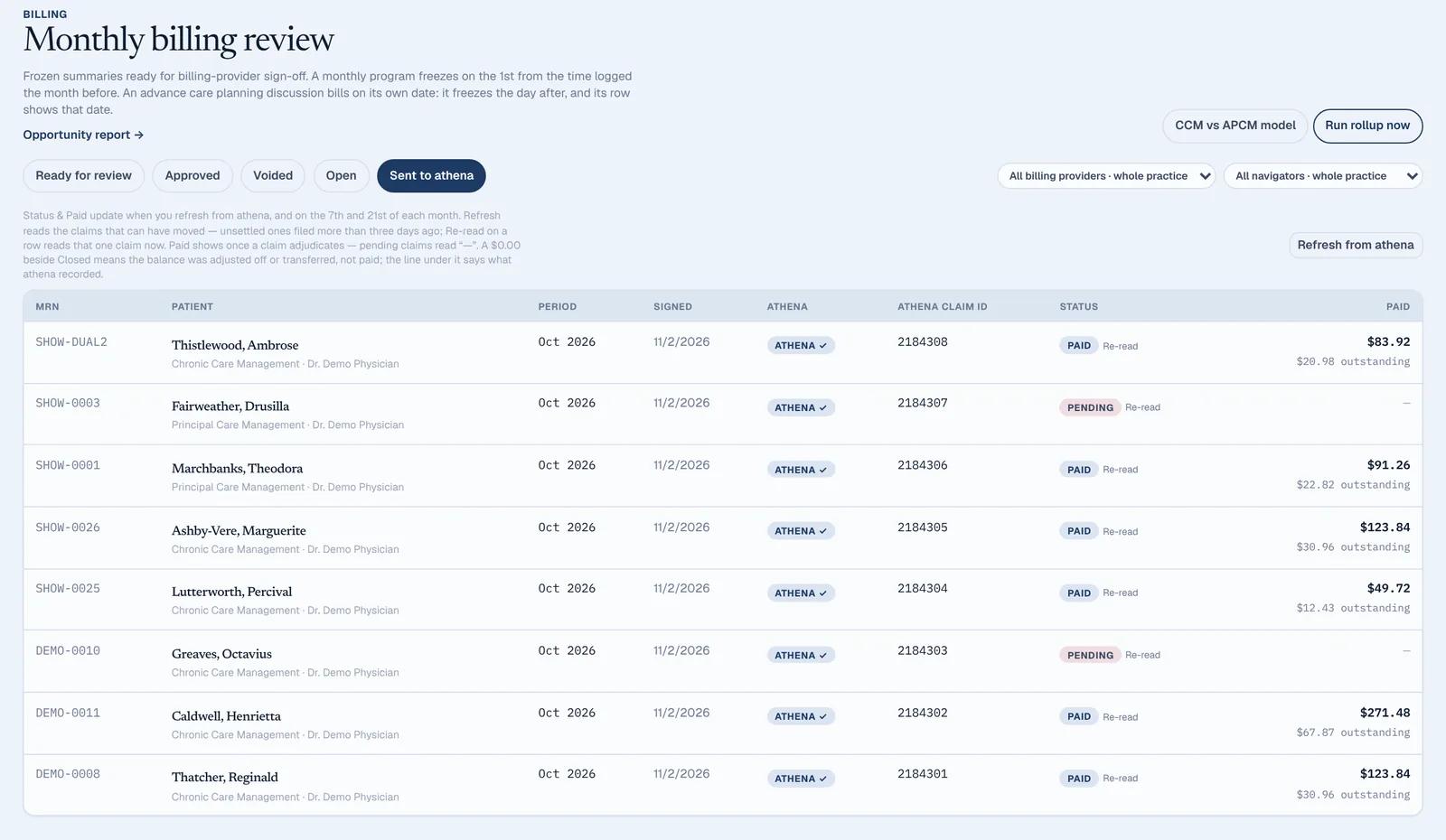
Once signed, willowbridge files each month as a claim in athenaOne, with the codes, dates of service, diagnoses and billing provider, and athena bills it. willowbridge reads the claim status back from athenaOne. By the 21st, six of the practice's eight claims show Paid, with the amount paid and the balance left to the patient. Two are still pending.
- The practice's billing stays in athenaOne.
- Each claim keeps its athena claim ID, so it can be looked up there.
The audit packet.
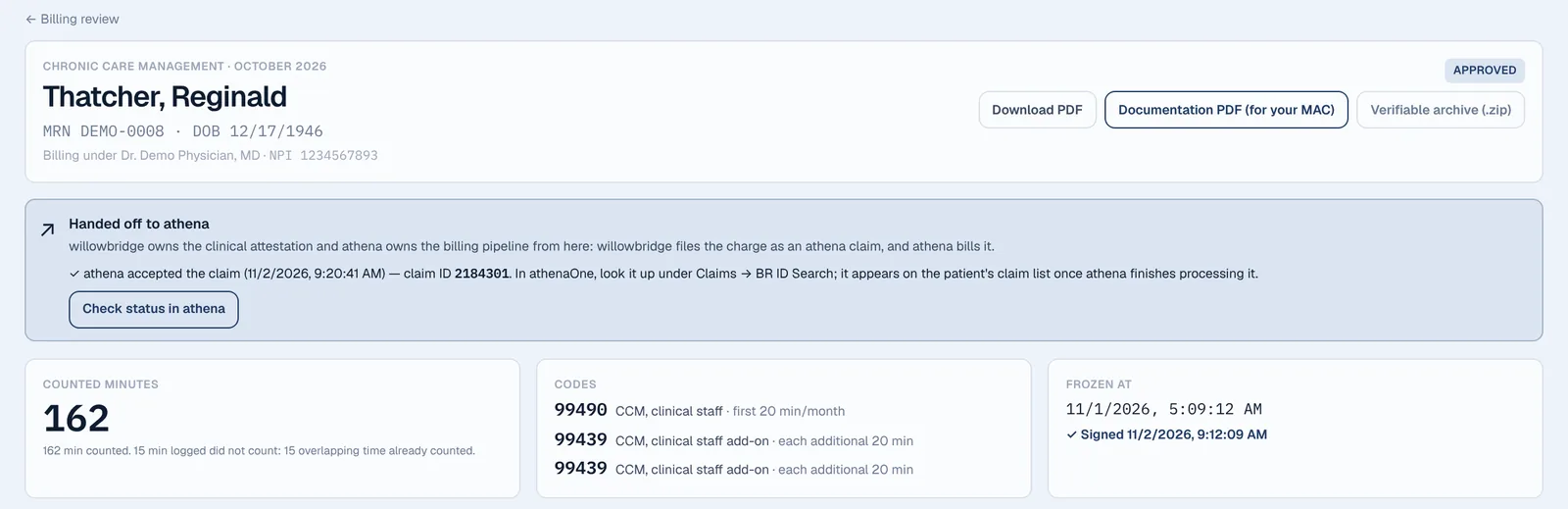
If a claim is ever questioned, the practice opens that patient's month. The billing page has the frozen minutes and codes, the signature, the athena claim ID, and three downloads: the bill as a PDF, a documentation PDF to send to the Medicare contractor, and a verifiable archive of the whole record.
- Built from the record as it was frozen, not reassembled from memory.
- The audit trail shows every change, with who made it and when.
The month in dollars.
What a month like this one could bill at Medicare's national rates. The counts are illustrative for a practice of this size, not a promise of what any practice will bill.
| Program | Code | Claims | National rate | Total |
|---|---|---|---|---|
| Chronic care management, first 20 minutes | 99490 | 60 | $66.13 | $3,967.80 |
| Chronic care management, each added 20 minutes | 99439 | 22 | $50.44 | $1,109.68 |
| Advanced primary care management | G0557 | 150 | $53.78 | $8,067.00 |
| Remote monitoring, device supply | 99454 | 42 | $52.11 | $2,188.62 |
| Remote monitoring, management, first 20 minutes | 99457 | 38 | $51.77 | $1,967.26 |
| Remote monitoring, management, 10 to 19 minutes | 99470 | 4 | $26.05 | $104.20 |
| Behavioral health integration, 20 minutes | 99484 | 12 | $57.45 | $689.40 |
| Transitional care, moderate complexity | 99495 | 5 | $220.11 | $1,100.55 |
| Transitional care, high complexity | 99496 | 3 | $298.60 | $895.80 |
| Home health certification | G0180 | 4 | $56.78 | $227.12 |
| Home health recertification | G0179 | 3 | $44.42 | $133.26 |
| The month | 343 | $20,450.69 | ||
Rates are the CY 2026 Medicare Physician Fee Schedule national non-facility amounts. What a practice is paid differs by locality, by whether the billing practitioner is a physician or a nurse practitioner or physician assistant, and after the patient's coinsurance and sequestration. A patient is billed for either chronic care management or advanced primary care management in a month, not both.
The same team, the same EHR, a complete month.
Nothing slipped
Discharges, recertifications, readings and calls due came to the team on one list, with their deadlines.
Every minute counted once
Time went to the right program and month as it was spent, and held months said why.
Ready if asked
Each billed month has its consent, care plan, minutes and signature in one packet.
athenaOne is a trademark of its owner. willowbridge connects to athenaOne through its published APIs; this page does not imply endorsement.